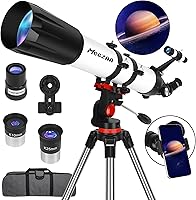
8 Best Telescopes for Moon Craters (October 2026)
The best telescopes for viewing lunar craters include the Gskyer Telescope for a compact starter setup, the Celestron AstroMaster 70AZ Refractor Telescope for Moon for simple lunar sessions, and the CELTICBIRD Telescope for Adults High Powered for portable 80mm optics.
On this page (7 sections)
- Which telescope is best for moon craters?
- The best telescopes for Moon craters
- What should you look for in a telescope for lunar craters?
- When are Moon craters easiest to observe?
- Is a refractor or reflector better for the Moon?
- How do you get a clearer view of crater detail?
- Which telescope should you choose for Moon craters?
The best telescope for moon craters for most beginners is the Celestron AstroMaster 70AZ, with simple altazimuth controls and a 900mm focal length. If you want more aperture for lunar detail and deep sky targets, consider the Celestron AstroMaster 130EQ, while the CELTICBIRD 80mm offers a portable kit with a Moon filter.
Moon craters are easiest to see when the Moon is not full, because sunlight then casts shadows along the boundary between day and night. A telescope helps you inspect that changing light and shadow, but stable support, sharp focus and a suitable eyepiece matter as much as a big magnification claim.
This roundup compares scopes by aperture, mount, included eyepieces and how practical they look for a beginner. For a broader lunar overview, read our best telescope for moon viewing picks.
Our picks at a glance
-
1
-
2
 Best for simple lunar sessions
Celestron AstroMaster 70AZ Refractor Telescope for Moon
9.7/10 our score
See it on Amazon -
3
 Best for portable 80mm optics
CELTICBIRD Telescope for Adults High Powered
9.5/10 our score
See it on Amazon
- 4
 Check it
Blue Marble NASA Lunar Telescope for Kids Ages
Best for children learning the Moon - 5
 Check it
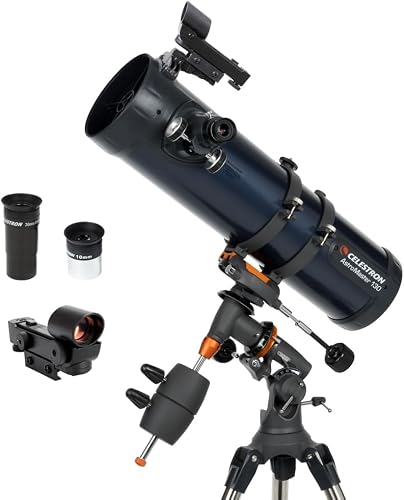
Celestron AstroMaster 130EQ Telescope for Deep-Sky Beginners
Best for larger aperture and tracking - 6
 Best for a phone-ready kids' kitCheck it
- 7
 Check it
Dianfan 150EQ Professional Astronomy Telescope for Adults
Best for a 150mm reflector - 8
 Best for a bundled refractor kitCheck it
Which telescope is best for moon craters?
The Celestron AstroMaster 70AZ is the simplest pick for a beginner who wants to point at the Moon and start observing. The 130EQ is the choice for a larger mirror and slower, controlled adjustments.
Our score weighs aperture, included accessories, mount style and beginner fit for lunar observing. We checked the listed specifications and features, but we did not test these telescopes in person.
| Product | Best for | Aperture | Focal length | Mount | Our score |
|---|---|---|---|---|---|
| Gskyer Telescope | a compact starter setup | 70mm | 400mm | Altazimuth | 9.7 |
| Celestron AstroMaster 70AZ Refractor Telescope for Moon | simple lunar sessions | 70mm | 900mm | Altazimuth | 9.7 |
| CELTICBIRD Telescope for Adults High Powered | portable 80mm optics | 80mm | 600mm | Altazimuth | 9.5 |
| Blue Marble NASA Lunar Telescope for Kids Ages | children learning the Moon | 9.4 | |||
| Celestron AstroMaster 130EQ Telescope for Deep-Sky Beginners | larger aperture and tracking | 130mm | 650mm | Equatorial | 9.3 |
| Jvcla Telescope for Kids | a phone-ready kids' kit | 70mm | 300mm | 8.7 | |
| Dianfan 150EQ Professional Astronomy Telescope for Adults | a 150mm reflector | 150mm | 650mm | Equatorial | 8.6 |
| UncleHu 80mm Aperture | a bundled refractor kit | 80mm | 600mm | Tripod mount | 7.9 |
The best telescopes for Moon craters
These picks cover easy refractors, portable kits and larger reflectors. Choose by the setup you are willing to learn and carry, rather than by maximum magnification alone.
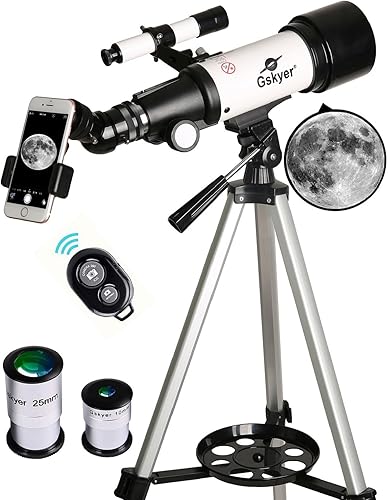
Gskyer Telescope: Best for a compact starter setup
- 70mm aperture
- 400mm focal length
- Altazimuth mount
- Carry bag and phone adapter
A 70mm refractor with a carry bag, phone adapter and wireless remote. Its compact kit suits beginners who want a telescope they can store or take along.
Pros
- Carry bag included
- Two eyepieces and 3x Barlow
- Phone adapter and wireless remote
Cons
- Shorter focal length than the 70AZ
- Tripod stability depends on setup
The Gskyer Telescope is a compact starter refractor for a beginner who wants a kit that can be stored or carried between home and a darker observing spot. Its 70mm aperture and 400mm focal length keep the tube short, while the included bag provides a place for the telescope and tripod.
It comes with two eyepieces, a 3x Barlow lens and a 5x24 finder scope. The phone adapter and wireless camera remote offer a way to try lunar photos through a smartphone, though getting a sharp, centered phone image still takes patience.
For ideas, see Moon photography telescopes.
The adjustable altazimuth tripod supports different viewing positions. As with any light setup, place it on firm ground and make small adjustments to reduce shake while focusing.
Choose this if portability and a ready-to-go accessory kit matter more than a longer focal length. It is a practical way to start, but its short tube and 70mm aperture make it less suited to someone prioritizing a larger light-gathering mirror.
Celestron AstroMaster 70AZ Refractor Telescope for Moon: Best for simple lunar sessions
- 70mm refractor
- 900mm focal length
- Manual altazimuth mount
- 20mm and 10mm eyepieces
A beginner refractor with a panhandle mount, two eyepieces and a red dot finder. The controls and quick setup make it an easy fit for backyard Moon viewing.
Pros
- Simple manual pointing
- Two eyepieces included
- Adjustable tripod
Cons
- 70mm aperture limits light gathering compared with larger scopes
- Manual tracking takes practice
The Celestron AstroMaster 70AZ suits a beginner who wants straightforward manual pointing for the Moon. Its 70mm achromatic refractor has a 900mm focal length, and its panhandle altazimuth mount moves up, down and side to side.
Two eyepieces, a red dot finder and an adjustable tripod are included. Start with the lower-power eyepiece to locate the lunar disk, then switch to the higher-power one and refocus; if the view softens, return to lower power.
The refractor design also supports daytime viewing of land targets, according to Celestron. The included erect image diagonal helps keep those views upright, while the red dot finder gives you a simple way to aim the tube before looking through the eyepiece.
Pick the 70AZ when quick setup and simple controls matter more than maximum aperture. If you want to compare scopes chosen specifically for planets, see our best telescope for looking at planets guide.
CELTICBIRD Telescope for Adults High Powered: Best for portable 80mm optics
- 80mm aperture
- 600mm focal length
- Moon filter
- Backpack and phone adapter
This 80mm refractor pairs a backpack and adjustable tripod with a Moon filter and phone adapter. Its kit is aimed at beginners who want more aperture in a portable package.
Pros
- 80mm aperture
- Moon filter included
- Backpack for storage and travel
Cons
- Manual altazimuth mount
- Included eyepieces offer 30x and 66x magnification
The CELTICBIRD telescope gives you 80mm aperture in a portable refractor kit. Its backpack, adjustable aluminum tripod and phone adapter make sense for a beginner who wants to carry the setup outside or store its accessories together.
The package includes 20mm and 9mm eyepieces, which the brand pairs with 30x and 66x magnification, plus a 5x24 finder scope. A Moon filter is included and is described as transmitting 13 percent of incoming light, which can make a bright lunar view more comfortable.
This is a useful middle ground between a small starter refractor and a reflector with a more involved mount. The altazimuth mount is manually operated, so you will need to keep nudging the telescope as the Moon moves across the sky.
Choose this if you want 80mm aperture, a carrying backpack and an included filter in one kit. Our moon telescope buying guide explains how aperture, eyepieces and mount choice affect your decision.
Blue Marble NASA Lunar Telescope for Kids Ages: Best for children learning the Moon
- Designed for ages 8 and up
- Low- and high-power eyepieces
- Finder scope
- Tabletop tripod
A child-focused lunar telescope with a tabletop tripod, finder scope and learning guide. The low- and high-power eyepieces support finding the Moon and then viewing it closer.
Pros
- Tabletop tripod included
- Learning guide included
- Made for young beginners
Cons
- Tabletop setup is less flexible than a full-height tripod
- Best suited to children and shared sessions
The Blue Marble NASA Lunar Telescope is designed for children ages 8 and up who are learning to locate and view the Moon. Its tabletop tripod and smooth mount make it easier to scan the lunar surface from a table or steady outdoor spot.
It includes low- and high-power eyepieces, a finder scope and a learning guide. The straightforward kit can make a first shared observing session feel manageable, with an adult helping the child locate the Moon and adjust focus.
A tabletop tripod is less flexible than a full-height tripod, so think about where the child will use it and whether the surface is stable. This is a focused choice for young learners rather than a general-purpose telescope for an adult looking to explore many kinds of targets.
Pick it when an age-appropriate lunar starter setup is the priority. For a wider comparison aimed at young observers, see our best telescope for beginners to see planets guide.
Celestron AstroMaster 130EQ Telescope for Deep-Sky Beginners: Best for larger aperture and tracking
- 130mm Newtonian reflector
- 650mm focal length
- Equatorial mount with slow-motion controls
- 20mm and 10mm eyepieces
A 130mm reflector with slow-motion controls and a red dot finder. Its larger aperture makes it the most capable option here for gathering light and exploring beyond the Moon.
Pros
- Largest aperture among the Celestron picks here
- Slow-motion control knobs
- Two eyepieces included
Cons
- Equatorial mount has a learning curve
- Heavier setup than a small refractor
The Celestron AstroMaster 130EQ is the stronger choice for a beginner ready to learn an equatorial mount. Its 130mm Newtonian reflector gathers more light than the smaller refractors here, and the slow-motion knobs help make controlled adjustments as you follow a target.
The package includes 20mm and 10mm eyepieces plus a red dot finder. Use the wide view to locate the Moon, then change eyepieces for a closer view while keeping the image sharp and centered.
An equatorial mount has a learning curve because its axes work differently from a simple up-down, left-right altazimuth mount. The 130EQ also weighs more than the small refractor options, so leave time to set it up and learn its controls.
Choose this when aperture and fine manual movement matter more than the quickest setup. If you are weighing the size and setup tradeoffs, our guide asks is an 8 inch telescope good for beginners?.
Jvcla Telescope for Kids: Best for a phone-ready kids' kit
- 70mm aperture
- 300mm focal length
- Phone adapter and wireless remote
- Two eyepieces and 3x Barlow
This 70mm refractor includes a phone adapter and wireless remote, plus eyepieces and a Barlow lens. It suits beginners who want a portable kit for Moon and nature viewing.
Pros
- Phone adapter and remote included
- Tool-free setup
- 70mm aperture
Cons
- 300mm focal length
- Magnification claims vary with included eyepiece combinations
The Jvcla Telescope for Kids is a 70mm refractor with a phone adapter and wireless remote. It is aimed at kids and beginners, and its tool-free setup and gift box may appeal to families looking for a portable first telescope.
The kit has two eyepieces, a 1.5x erecting eyepiece, a 3x Barlow lens and a 5x24 finder scope. The stated 15x–150x range depends on the eyepiece combination; for the Moon, begin at lower power and use a higher setting only while the image remains clear.
Its 300mm focal length is shorter than the Celestron 70AZ's 900mm, so compare the intended setup and your expectations before choosing. The phone adapter can help you experiment with snapshots, but phone alignment and focus take practice.
Pick this for a beginner kit that includes phone accessories and can also be used for nature viewing. Our ZWO Seestar S30 Pro review covers a different, app-based approach to capturing sky objects.
Dianfan 150EQ Professional Astronomy Telescope for Adults: Best for a 150mm reflector
- 150mm aperture
- 650mm focal length
- Equatorial mount with slow-motion controls
- Two eyepieces and 2x Barlow
A 150mm reflector with an equatorial mount, phone adapter and carry bag. Its larger aperture suits buyers who are comfortable learning a more involved setup.
Pros
- 150mm aperture
- Slow-motion tracking controls
- Carry bag included
Cons
- Equatorial mount takes practice
- The full kit is heavier to transport
The Dianfan 150EQ is for a buyer who wants 150mm aperture and is comfortable with a larger equatorial setup. It pairs a 650mm focal length with a German-style mount and slow-motion controls for fine adjustments.
Two eyepieces and a 2x Barlow lens support a stated magnification range of 26x–130x. The kit also includes a red dot finder, phone adapter, carry bag and stainless steel tripod, so you can store and transport its parts together.
The larger aperture can be useful for more than lunar viewing, but the equatorial mount takes time to understand. For planetary observing, compare telescopes for Saturn’s rings.
The full setup is a more involved choice than a short refractor with an altazimuth mount.
Consider it if you want to explore the Moon and other night-sky targets with a 150mm reflector. If easy first use matters more than aperture, choose one of the refractors above.
UncleHu 80mm Aperture: Best for a bundled refractor kit
- 80mm aperture
- 600mm focal length
- Three eyepieces and 3x Barlow
- Tripod and carry bag
An 80mm refractor bundled with three eyepieces, a Barlow lens, finder scope and carry bag. It offers a broad accessory set for beginners who want to try different magnifications.
Pros
- 80mm aperture
- Three eyepieces and 3x Barlow
- Carry bag and phone adapter
Cons
- Tripod mount type is less specific
- Very high magnification claims are not a useful lunar buying target
The UncleHu 80mm Aperture refractor suits a beginner who wants several eyepieces and a broad accessory kit. It includes 23mm, 10mm and 4mm eyepieces, a 3x Barlow lens, finder scope, phone adapter and carry bag.
Its 600mm focal length and 80mm aperture give it a useful place between smaller beginner refractors and the larger reflectors. The adjustable tripod has 360-degree horizontal and 180-degree vertical movement, according to the product details, and its 45-degree diagonal provides an upright image for daytime use.
The stated 26x–450x range is not a reason to aim for the highest setting. Start low, focus carefully and increase magnification only while the Moon's edge and crater shadows stay clear.
Choose this if you value a portable kit with several ways to change magnification. For a beginner, the included controls and accessories matter more than an extreme magnification number.
What should you look for in a telescope for lunar craters?
For Moon craters, prioritize aperture, a stable mount and eyepieces you can use at practical magnifications. A high maximum-magnification figure alone does not guarantee a sharp view.
Aperture is the diameter of the telescope's main lens or mirror. Larger apertures gather more light and can show finer detail when the optics, focus and sky conditions cooperate, but they also tend to make the telescope larger and heavier.
For a larger size, see 10-inch aperture telescopes.
The mount affects how easy it is to keep a crater in view. An altazimuth mount moves in simple up-down and side-to-side directions, while an equatorial mount takes more setup but can track the sky with motion along one axis after alignment.
Focal length and eyepiece choice determine magnification. Divide the telescope's focal length by the eyepiece's focal length to estimate magnification; a Barlow lens increases it, but a blurry view is a sign to step back to lower power.
When are Moon craters easiest to observe?
Craters stand out most along the Moon's terminator, the boundary between its sunlit and dark sides. At that angle, sunlight creates long shadows that make crater rims and slopes easier to distinguish.
The terminator shifts as the Moon moves through its phases, so the best views change from night to night. A full Moon is bright, but its direct light makes surface relief look flatter than it does near the day-night boundary.
Let the telescope adjust to outdoor temperature before observing, and give your eyes a few minutes to settle in the dark. Focus on a bright edge, then make small adjustments until the rim looks crisp.
Is a refractor or reflector better for the Moon?
A refractor is often simpler to carry and use, while a reflector can provide more aperture for the money and a larger view of faint targets. Your best fit depends on whether portability or light gathering matters more.
The Gskyer, Celestron 70AZ, CELTICBIRD, Blue Marble, Jvcla and UncleHu are refractors. They use a lens at the front of the tube and generally offer a straightforward setup for a first lunar session.
The Celestron 130EQ and Dianfan 150EQ are reflectors with larger mirrors and equatorial mounts. They can be a better fit if you want a scope for Moon viewing plus other sky objects, and you are ready to learn a more involved mount.
How do you get a clearer view of crater detail?
Use low magnification to find and center the Moon, then increase power in small steps until the image starts to lose sharpness. A steady tripod, careful focus and patient viewing often make more difference than pushing to the highest magnification.
Make sure the finder scope is aligned with the main telescope before your observing session. Once the Moon is centered, use the focus control slowly and let vibrations settle before judging detail.
Try observing when the Moon is near a quarter phase, when the terminator crosses many craters. Atmospheric turbulence can soften the view, so if the image wavers, lower the magnification or wait for a steadier moment.
Avoid looking at the Sun through a telescope or finder scope. Keep the telescope pointed well away from it, and use the manufacturer's safety instructions for your specific setup.
Which telescope should you choose for Moon craters?
Choose the Celestron AstroMaster 70AZ if you want simple manual controls and quick lunar setup. Pick the CELTICBIRD 80mm for a portable refractor kit with a Moon filter, or the Celestron AstroMaster 130EQ if you want a larger mirror and can spend time learning an equatorial mount.
For a child learning to find the Moon, the Blue Marble tabletop telescope has a focused beginner setup. If crater detail is your main goal, start with steady support and low power, then work up only as far as the image stays sharp.
Our top 3 picks at a glance
-
1
-
2
Best for simple lunar sessions
Celestron AstroMaster 70AZ Refractor Telescope for Moon
9.7/10 our score
See it on Amazon -
3
Best for portable 80mm optics
CELTICBIRD Telescope for Adults High Powered
9.5/10 our score
See it on Amazon
Frequently asked questions
What telescope is best for seeing craters on the Moon?
A telescope with steady support and enough aperture to give a sharp view is a good starting point. The Celestron AstroMaster 130EQ has a 130mm mirror, while the 70mm and 80mm refractors here offer simpler, more portable setups.
Seeing detail also depends on focus, atmospheric steadiness and magnification.
Can a beginner telescope show Moon craters?
Yes. Beginner refractors such as the Celestron AstroMaster 70AZ can show lunar features when focused well and used at a sensible magnification.
Start with a low-power eyepiece to find and center the Moon, then try a higher-power eyepiece if the image stays sharp.
Do I need a Moon filter to see craters?
No. You can observe lunar craters without a Moon filter.
A filter can reduce brightness and may make viewing more comfortable, especially when the Moon is near full.
The CELTICBIRD telescope includes a Moon filter, but a filter does not create additional detail.
What magnification is best for lunar viewing?
Begin at low magnification, then increase it until the image becomes soft or hard to keep centered. The best setting changes with the telescope, eyepiece and viewing conditions.
A higher number does not always reveal more detail, so judge the image by sharpness.
Can I take photos of Moon craters with a beginner telescope?
Many beginner telescopes can hold a phone adapter, but getting a steady, focused image takes practice. The Gskyer and CELTICBIRD kits include phone adapters, and the Jvcla includes an adapter and wireless remote.
For dedicated imaging choices, see our guide to the best telescope for moon photography.