Canon 15x50 IS Binoculars Review: Worth It? (November 2026)
The Canon 15x50 IS binoculars are built for detailed handheld sky viewing when you want 15x magnification without constantly fighting hand shake. Their 50mm objectives and optical image stabilization make them the strongest fit here for steady, high-power astronomy use.
On this page (10 sections)
- Canon 15x50 IS binoculars review: what stands out
- How effective is image stabilization at 15x?
- What do the Canon's 15x50 numbers mean?
- Canon 15x50 IS binoculars versus the Vortex Crossfire HD 12x50
- Canon 15x50 IS binoculars versus 20x50 binoculars
- How to set up Canon 15x50 IS binoculars
- What should you look for in astronomy binoculars?
- Care and storage for high-power binoculars
- Best Canon stabilized binoculars for this use
- Canon 15x50 IS binoculars review: final verdict
The Canon 15x50 IS binoculars are the best fit here for detailed handheld sky viewing at 15x power. Their Optical Image Stabilizer compensates for hand shake and minute vibrations, while the 50mm objective lens supports a wide, extra-bright field of view.
That combination suits adults who want to study selected details without setting up a mount for every short observation. It can work well for the Moon, bright clusters and other targets where a steadier high-power view makes fine detail easier to follow.
The stabilizer does not make the binoculars light. At 2.6 lb, they are heavier than the Vortex Crossfire HD 12x50, so a relaxed grip and a supported position still matter during longer sessions.
The 15x magnification also rewards careful aiming. Find a broad area first, centre the target, focus with the central control and then switch on stabilization when the view is ready.
The 236.2 ft field of view is narrower than the Vortex figure of 273 ft. That means less surrounding sky for scanning, but more enlargement when you have already found the target you want to examine.
The 15mm eye relief gives space for comfortable eye placement, including for glasses wearers who use the fold-down eyecups. Multi-coated ultra-low dispersion objective elements are aimed at contrast, clarity and colour fidelity.
The main trade-off is therefore size against steadiness. If you value detailed handheld views and accept the extra weight, this Canon model offers a clear purpose.
Canon 15x50 IS binoculars review: what stands out
The Canon 15x50 IS binoculars stand out because they combine 15x magnification with optical image stabilization. That combination targets a specific problem: high magnification reveals more detail, but it also makes small hand movements easier to see.
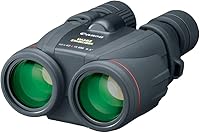
Canon 4625A002 15x50 is Image Stabilized Binocular: Best for handheld astronomy

- 15x magnification
- 50mm objective lens
- Optical Image Stabilizer
- 15mm eye relief
A high-power Canon binocular with optical image stabilization, a 50mm objective lens and 15mm eye relief. It suits adults who want detailed sky views without mounting every observation.
Pros
- Optical Image Stabilizer compensates for hand shake and minute vibrations
- 15x magnification suits detailed distant viewing
- 50mm objective lens gives a wide, extra-bright field of view
- Multi-coated ultra-low dispersion objective elements
Cons
- 2.6 lb weight is substantial for extended handheld viewing
- 15x magnification demands careful handling
- 236.2 ft field of view is narrower than the Vortex option
The Canon has a 50mm objective lens and an apparent angle of view of 67.5 degrees. Its field of view is 236.2 ft, and the 15mm eye relief gives adults room to position their eyes comfortably.
The binoculars use a Porro prism optical path, central focus and fold-down rubber eyecups. The enclosure is made from acrylonitrile butadiene styrene, with weatherproof slip-resistant armor listed among the features.
Who should choose Canon 15x50 IS binoculars?
Choose the Canon if you want high power without relying on a tripod for every short observation. The stabilizer is most useful when you are standing, scanning the Moon or viewing distant details in the sky.
The 15x power also makes careful aiming more important. Start with a wide target, bring the binoculars to your eyes, focus centrally and then activate stabilization when the view is close to the detail you want.
Skip this model if low weight and quick scanning matter more than reach. In that case, the Canon 10x42L IS WP Binoculars Review offers a useful comparison point within Canon's stabilized range.
How effective is image stabilization at 15x?
Image stabilization helps by compensating for hand shake and minute vibrations, but it doesn't turn a 2.6 lb binocular into a lightweight one. You still need a balanced grip and a comfortable viewing position.
Hold the barrels securely without squeezing them tightly. Rest your elbows against your body when possible, and use a seated position for longer observations.
Canon's stabilizer works at the touch of a button. Use it after you have found the target so you don't spend extra time trying to center a moving view.
High magnification also narrows the practical margin for poor focus. Adjust the central focus carefully, then make small changes while watching the finest visible detail.
For a broader comparison, our guide to the best image stabilized binoculars explains when stabilization is worth prioritizing over lower weight or a wider view.
What do the Canon's 15x50 numbers mean?
The 15x means the binoculars enlarge the view 15 times compared with unaided viewing. The 50mm objective lens is the front lens size, and it helps gather light for a brighter view than a smaller objective can provide when other factors are similar.
The Canon's exit pupil diameter is 3.3mm. Its 15mm eye relief gives you space between the eyepiece and your eye while keeping the viewing circle usable.
The 236.2 ft field of view gives you less surrounding area than the Vortex's 273 ft figure. That can make the Canon better for examining a selected target, while a wider field can make initial scanning easier.
The objective elements use multi-coated ultra-low dispersion glass, and the binoculars have Fully Super Spectra Coatings. These optical details are aimed at contrast, clarity and color fidelity.
Canon 15x50 IS binoculars versus the Vortex Crossfire HD 12x50
The Canon is the better choice for stabilized 15x viewing, while the Vortex is the more flexible option if you value a wider field and tripod adaptability.
Vortex Crossfire HD 12x50 Binoculars: Best for rugged versatility

- 12x magnification
- 50mm objective lenses
- HD optics
- Tripod adaptable
A 12x50 option with HD optics, a wider 273 ft field of view and tripod adaptability. It fits buyers who want astronomy binoculars that also handle outdoor use.
Pros
- Wider field of view than the Canon
- Tripod adaptable
- Waterproof, fogproof and shockproof design
- Includes GlassPak binocular case and harness
Cons
- No image stabilization
- 12x magnification shows less detail than 15x
- Manual focus requires careful adjustment
The Vortex Crossfire HD 12x50 Binoculars use 12x magnification and 50mm objective lenses. Their field of view is 273 ft, which is wider than the Canon's 236.2 ft figure.
Vortex lists HD optics, fully multi-coated lenses, a roof prism design and a center focus wheel. The right eyepiece has a diopter adjustment for differences between your eyes, with a range of ±5 diopters.
The Vortex weighs 1.8 lb, making it 0.8 lb lighter than the Canon. It is also tripod adaptable, which can be useful when you want a fixed view without depending on image stabilization.
This model has adjustable twist-up eyecups, rubber armor, nitrogen purging and O-ring seals. The listed design is waterproof, fogproof and shockproof, and it includes a GlassPak binocular case, rainguard eyepiece cover, tethered objective lens cover, comfort neck strap and lens cloth.
Which is better for astronomy, Canon or Vortex?
Pick the Canon for high-power handheld astronomy and the Vortex for a wider, lighter and more adaptable setup. The Vortex's 12x power may feel easier to control during scanning, while the Canon provides more enlargement for selected details.
If you observe from a fixed spot, the Vortex's tripod adaptability can reduce the importance of image stabilization. If you often observe while standing or moving between targets, the Canon's stabilizer is the more direct solution.
Canon 15x50 IS binoculars versus 20x50 binoculars
The Canon gives you stabilized 15x viewing, while the FLYANT offers the highest magnification in this comparison at 20x. More power can reveal finer distant detail, but it also makes hand movement more obvious.
FLYANT 20x50 High Powered Binoculars for Adults: Best for maximum magnification

- 20x magnification
- 50mm objective lens
- 26mm eye relief
- Tripod mount
The FLYANT offers the highest magnification here, plus a tripod mount, 26mm eye relief and a 50mm objective lens. It makes more sense when maximum reach matters more than stabilized handheld viewing.
Pros
- Highest magnification in this comparison
- 26mm eye relief
- Tripod mount
- Center focus and rubber-coated grip
Cons
- No image stabilization
- Higher magnification makes hand movement more visible
- The 2.5mm exit pupil is smaller than the Canon and Vortex figures
The FLYANT 20x50 High Powered Binoculars for Adults use a 20x magnification eyepiece and a 50mm objective lens. The product data gives a field of view of 168 yd at 1000 yd, along with a 2.5mm exit pupil and 26mm eye relief.
The binoculars use multilayer-coated aspherical lens elements, a BAK4 Porro prism and green FMC anti-reflective coating on the objective lens. They have center focus, a rubber-covered focus wheel and a rubber-coated body.
FLYANT lists a daily waterproof body, impact resistance and textured non-slip handles. The instructions caution against immersing the binoculars in water.
The FLYANT has a tripod mount, which matters at 20x. It also includes a clean cloth, manual and storage bag.
Its stated compatible device is a smartphone, and its low light technology is listed as yes.
Are 20x50 binoculars good for stargazing?
The FLYANT can suit stargazers who want maximum magnification and plan to use a tripod mount. Its 20x power reaches farther into a selected view than the Canon's 15x setting, but the lack of image stabilization makes support more important.
Our guide to what 20x50 binoculars are good for explains why high power can be useful for distant targets but less convenient for quick, sweeping views.
How to set up Canon 15x50 IS binoculars
Set up the Canon by adjusting the barrel spacing, eyecups and central focus before judging the view. The goal is one clear image that stays comfortable when the stabilizer is active.
First, adjust the two barrels until the image merges into one circle. If you use glasses, fold down the rubber eyecups and keep the binoculars steady against your face.
Use the large center focusing knob to sharpen the target. Make small adjustments because 15x magnification makes focus changes easy to notice.
Activate the Image Stabilizer once the target is centered. If the view still moves, change your body position before gripping harder.
For a lower-power Canon comparison, read our Canon 10x32 IS Binoculars Review. A 10x32 design may suit readers who value easier scanning and lower carrying demands over the Canon 15x50's larger objective lens.
What should you look for in astronomy binoculars?
The best astronomy binoculars balance magnification, objective size, steadiness, eye comfort and weight. A higher number is not automatically better if you cannot keep the view stable or hold the binoculars for the length of an observation.
Magnification affects detail and steadiness. Objective size affects the amount of light entering the binoculars, while exit pupil helps describe the light beam reaching your eye.
Eye relief matters if you wear glasses. The Canon and Vortex both list 15mm eye relief, while the FLYANT lists 26mm.
A tripod mount or tripod adaptability can change how useful high power feels. The Vortex and FLYANT include that option in their product data, while the Canon's defining feature is its Optical Image Stabilizer.
For general selection help, use our guide on what binoculars to buy. It can help you decide whether astronomy binoculars, stabilized binoculars or a lower-power pair fits your normal viewing.
Care and storage for high-power binoculars
Keep high-power binoculars clean, dry and protected from sudden knocks. Store them with the objective and eyepiece areas covered when they are not in use, and avoid touching optical surfaces with your fingers.
Use a clean lens cloth for routine dust removal. If grit is present, follow the manufacturer's cleaning instructions rather than rubbing it across the glass.
Don't leave binoculars where heat, moisture or direct sunlight can build up. If condensation forms after moving between temperatures, let the binoculars adjust gradually before wiping them.
For the Canon, use the slip-resistant armor as handling protection, not as permission to treat the binoculars roughly. The stabilizer compensates for hand movement, but it doesn't protect the optics from impact.
Best Canon stabilized binoculars for this use
The Canon 15x50 is the strongest pick here for detailed handheld astronomy at 15x. It combines the most relevant features for that use: Optical Image Stabilizer, a 50mm objective lens, ultra-low dispersion objective elements and 15mm eye relief.
The best Canon stabilized binoculars comparison is the next useful read if you are deciding between Canon models rather than comparing Canon with Vortex and FLYANT.
The Vortex Crossfire HD 12x50 is the better fit for a lighter, wider-view setup with tripod adaptability. The FLYANT 20x50 is the better fit when 20x magnification matters most and you are prepared to use its tripod mount.
Canon 15x50 IS binoculars review: final verdict
The Canon 15x50 IS binoculars are worth choosing for stabilized, high-power handheld viewing. Pick them when 15x detail and a 50mm objective lens matter more than low weight or the widest field of view.
Their Optical Image Stabilizer helps offset hand shake and minute vibrations at the touch of a button. The 15mm eye relief and multi-coated ultra-low dispersion objective elements also support comfortable, clear viewing.
Choose the Vortex if you want 12x scanning, a wider field, a lighter body and tripod adaptability. Choose the FLYANT if you want 20x magnification, 26mm eye relief and a tripod mount, and you accept that it has no image stabilization.
Frequently asked questions
Are Canon 15x50 IS binoculars good for astronomy?
Canon 15x50 IS binoculars suit astronomy when you want detailed handheld views of the sky. Their 15x magnification, 50mm objective lens and Optical Image Stabilizer address the main challenge of high-power binocular use: hand movement.
A tripod can still help during long sessions.
How does image stabilization help on Canon 15x50 binoculars?
The Canon 15x50 IS binoculars use Optical Image Stabilizer technology to compensate for hand shake and minute vibrations at the touch of a button. That can make 15x viewing easier to hold steady, though stabilization doesn't reduce the binoculars' 2.6 lb weight.
Are 15x50 binoculars better than 10x42 binoculars?
15x50 binoculars provide higher magnification and a larger objective lens than 10x42 binoculars, which can help with detailed distant viewing. A 10x42 design is usually easier to scan with because it uses lower power, so choose based on detail, steadiness and how long you'll hold the binoculars.
Can you use Canon IS binoculars on a tripod?
You can use Canon IS binoculars handheld with their stabilization system, while a tripod can provide another way to reduce movement during long observations. The Canon model's key advantage is its Optical Image Stabilizer, so tripod use is most useful when you want a fixed viewing position.