Nikon Aculon A30 10x25 Binoculars Review: Worth It? (November 2026)
The Nikon ACULON A30 10x25 suits buyers who want small, light binoculars they will actually carry. It pairs 10x magnification with a 9.76-ounce body, multilayer-coated lenses and smooth central focus for hiking, travel and daytime nature watching.
On this page (9 sections)
- The Nikon Aculon A30 at a glance
- Who the Nikon Aculon A30 suits best
- Nikon Aculon A30 binoculars review: specs that matter in daily use
- How the dual hinge and ergonomics help on the trail
- Setup: focusing, diopter and glasses use
- Care and safe handling in the field
- Trade-offs: where the A30 wins and where it loses
- Alternatives in this review
- Verdict: should you buy the Nikon Aculon A30?
The Nikon ACULON A30 10x25 is a strong pick for compact daytime viewing, not a full replacement for larger astronomy binoculars. Its 10x magnification and 25 mm lenses keep the body small, while Nikon multilayer coatings help keep images bright and clear.
Our score weighs specs, features and buyer feedback against what you are shopping for. In this Nikon Aculon A30 binoculars review, we compared size, weight, eye relief and light gathering against two close alternatives.
The A30 scored highest here because its stated size and weight fit the compact brief so closely.
The Nikon Aculon A30 at a glance
The A30 offers 10x magnification in a 9.76-ounce pocket-friendly body. Nikon says the dual-hinge design folds down for easy storage, and the ergonomic shape is meant for a secure grip during extended viewing.
Nikon ACULON A30 10x25 Compact Binoculars: Best for pocketable Nikon optics
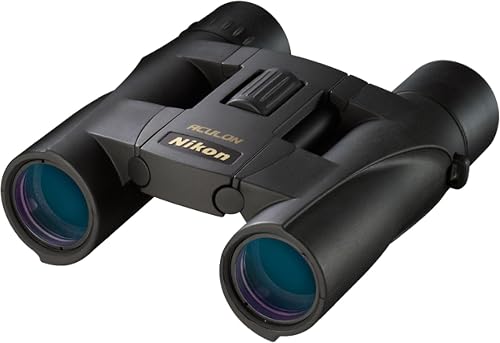
- 10x magnification
- 25 mm objective lenses
- 9.76 ounces
- Multilayer-coated lenses
- Smooth central focus
- Dual-hinge folding design
A very small Nikon pair built for travel and short outdoor trips. It suits daytime viewing where carry size matters more than low-light brightness.
Pros
- Folds down for pocket or pack carry
- Light enough for long walks
- Nikon multilayer coating
- Large central focus knob
- Ergonomic grip for extended viewing
Cons
- 25 mm lenses gather less light than 42 mm models
- 2.5 mm exit pupil is tight in dim light
- 10.6 mm eye relief leaves less room for glasses wearers
We checked the specs before comparing it with the other models. The A30 measures 4.8 x 4.5 x 1.7 inches, with a 5.2 degree apparent angle of view and a 262 ft field of view at 1,000 yards.
Those numbers point to a daytime travel pair first and a night-sky pair second.
The lenses use lead- and arsenic-free glass with anti-reflective multilayer coating. Nikon says that helps light transmission, contrast and color accuracy in low light.
The coating can help, but it cannot erase the basic limit of a small 25 mm objective.
If you want a broader shortlist before you decide, our what binoculars to buy guide explains how magnification, lens size and eye relief trade off against each other. Start there if terms like exit pupil feel new.
Who the Nikon Aculon A30 suits best
The A30 suits hikers, travelers and birdwatchers who want binoculars in a pocket or daypack. Its light weight matters on long walks, and its folding design saves space for other gear.
It also suits casual backyard use for the Moon, bright planets and daytime wildlife. Nikon positions it for hunting, hiking, birdwatching and outdoor adventures, and that list matches its compact build.
It suits buyers who value a known optics brand in a small form. Nikon Sport Optics makes this model, and the anti-reflective coating and eco-glass specs give it a clear place in the compact class.
It is a weaker fit for serious stargazing. A 2.5 mm exit pupil means the light beam reaching your eye is narrow, so dim stars and faint nebulae will be hard to enjoy.
Our best lightweight binoculars for stargazing guide helps if night viewing is your main goal.
It is also a weaker fit for many glasses wearers. Eye relief is only 10.6 mm, so you may not see the full field with glasses on.
Compare that with the 20 mm eye relief on the Occer model below before you buy for long sessions.
Nikon Aculon A30 binoculars review: specs that matter in daily use
The specs that matter most are 10x magnification, 25 mm objectives and a 2.5 mm exit pupil. That mix gives you reach without much weight, but it leaves little margin in dim light.
Magnification at 10x is a sweet spot for handheld use. It brings distant birds, boats and trail landmarks closer while staying easier to hold steady than 12x or higher.
You still need a steady grip, and bracing your elbows helps.
Objective size is 25 mm, much smaller than a 42 mm pair. Smaller lenses gather less light, so images will darken faster at dawn, dusk or under trees.
For bright daytime use, that trade is often worth it for the reduced carry load.
Exit pupil is 2.5 mm, calculated from the 25 mm objective divided by 10x magnification. A small exit pupil can make the view feel dimmer and harder to align, especially when your pupils dilate at night.
That is a key reason large astronomy binoculars use bigger lenses.
Eye relief is 10.6 mm, which is short. Non-glasses users can usually get close enough to the eyepiece.
Glasses wearers may see blackouts or a narrowed field, so comfort checks matter more here than with longer-relief models.
The focus system uses a large central knob with manual center focus. Nikon describes it as smooth and fast for near or distant subjects.
Diopter adjustment ranges ±5 diopters, so you can correct small differences between your eyes without relying only on the center wheel.
Field of view is 262 ft at 1,000 yards, with a 5.2 degree apparent angle. That is enough to scan a ridge or a stadium without constant panning.
It is narrower than the PROSTAFF P3 at 367 ft, so you will move the binoculars more to follow birds.
How the dual hinge and ergonomics help on the trail
The dual-hinge design is the main reason the A30 carries so well. It folds down to 1.7 inches tall, which helps it slide into a jacket pocket, side pouch or small camera bag.
Nikon says the ergonomic body gives a secure, natural grip and reduces hand fatigue. The polyester blend body and plastic enclosure keep weight down at 9.76 ounces.
That matters when you carry water, layers and other hiking gear all day.
A light pair also changes how often you use it. Binoculars left in a car or at home do not help you identify birds or read trail signs.
The A30 format makes spur-of-the-moment use more likely.
Balance matters as much as weight. A compact body can feel front-heavy or cramped if the barrels are short.
Nikon says the A30 maintains excellent balance during extended viewing, and its central focus knob placement should keep your fingers away from the lenses.
For travel, size affects total pack load. If you compare it with our best compact lightweight binoculars list, focus on folded height, weight and eye relief together.
Small size alone does not guarantee comfort.
Setup: focusing, diopter and glasses use
Setup is simple: raise the binoculars, focus on a distant object, then fine-tune each eye. Start with the center wheel on a distant tree or building before you narrow your eyes to one barrel.
Set the diopter with one eye closed at a time. Many buyers focus the left barrel first, then adjust the right barrel with the diopter control.
Once set for your eyes, you should need only the center wheel for most subjects.
Check eye position before you judge sharpness. Hold the binoculars steady, bring the eyepieces close to your eyes and look through the center of each lens.
Small shifts can cause dark edges, especially with short eye relief.
Glasses wearers should test the full field at home. Put your glasses on, raise the binoculars and see whether you can see edge to edge without blackouts.
If you cannot, consider a longer-relief model instead of forcing this pair.
For night use, let your eyes adapt for several minutes. Avoid bright phone light before looking at the Moon or bright planets.
A small pair rewards patience because faint detail is limited by light gathering.
Care and safe handling in the field
Care for the A30 with gentle cleaning and dry storage. Wipe lenses only with a soft lens cloth, and avoid touching coated surfaces with fingers.
Keep the binoculars in a pocket, pouch or pack section where they will not knock against hard gear. The plastic enclosure is light, not armored like a full-size rubber model, so extra padding helps.
Avoid leaving them in a hot car or damp tent for long periods. Heat and moisture can cause fogging on any optics, and dry storage helps the focus mechanism and coating last longer.
Do not force the hinges. Fold them flat for storage, then open them fully before use.
If the focus feels stiff after dust or grit exposure, use short gentle turns rather than long hard twists.
For astronomy use, carry them in a case so dust stays off the lenses. Even a soft pouch helps, because small lenses show smudges quickly when you look at bright stars.
Trade-offs: where the A30 wins and where it loses
The A30 wins on carry size, light weight and fast deployment. At 9.76 ounces and 4.8 inches long, it is far easier to bring than a 1.3 lb full-size pair.
It loses on low-light performance. The 25 mm objectives and 2.5 mm exit pupil limit brightness compared with a 10x42 model.
That gap shows at dusk, in forests and during night-sky viewing.
It also loses on eye relief. At 10.6 mm, it is short for glasses wearers and tight for some non-glasses users who like to hold the eyepiece farther out.
Longer relief is a comfort feature, not a luxury, for long sessions.
It loses on field of view compared with the PROSTAFF P3. The A30 field is 262 ft at 1,000 yards, while the 10x42 Nikon reaches 367 ft.
A wider field helps you find moving birds and scan stars faster.
It wins on simplicity. Center focus, a compact roof prism design and eco-glass keep the design focused on travel use.
There are no extra modes or heavy armor to carry.
Our best 8x32 binoculars guide is worth a look if you want a wider field with less magnification. An 8x32 pair can feel steadier and brighter for some users, though it will not reach as far as 10x.
Alternatives in this review
The alternatives below solve different problems. Pick by carry size, light gathering or eye relief, not by magnification alone.
Occer 12x25 Compact Binoculars for Adults
The Occer gives you 12x magnification with much longer eye relief. Its 20 mm eye relief and 15 mm large eyepieces suit glasses wearers who struggle with the A30.
It uses fully multi-coated optics with BAK4 prisms and FMC broadband coating. The field of view is 273 ft at 1,000 yards, a little wider than the A30 in practical scanning.
The trade is weight and steadiness. It weighs 0.39 kg, about 13.8 ounces, so it is heavier than the A30.
Higher magnification also makes hand shake more visible.
It suits adults and kids for bird watching, travel, sightseeing and sports. The ABS plastic body and rubber armor give a secure grip, but the same 25 mm objective size still limits low-light use.
Nikon PROSTAFF P3 10x42 Binocular
The PROSTAFF P3 solves brightness and weather sealing. Its 42 mm lenses gather far more light than 25 mm lenses, and the exit pupil is 4.2 mm instead of 2.5 mm.
It is waterproof down to 3.3 ft and fogproof with nitrogen purging and O-ring seals. Nikon says it stays clear in rain, snow, humidity and rapid temperature changes.
Eye relief is 15.7 mm with turn-and-slide eyecups, which is more comfortable than the A30 for many users. The field of view is 367 ft at 1,000 yards, so scanning is easier.
The trade is size and weight at 1.3 lb and 5.91 x 5.12 x 2.13 inches. It will not fold into a jacket pocket like the A30.
If you travel light, that size can decide against it.
It suits birding, hiking, boating, sports and stargazing. The fiberglass-reinforced polycarbonate body and rubber armor add durability for rougher use.
If travel is your priority, our best lightweight binoculars for travel guide shows how full-size and compact models compare for pack carry. Use it to weigh brightness against daily weight.
Verdict: should you buy the Nikon Aculon A30?
Buy the A30 if portability is your top priority and most viewing is in daylight. It is light, folds down and gives you 10x reach with Nikon coatings and smooth central focus.
Buy the Occer 12x25 if you wear glasses and need longer eye relief. Its 20 mm eye relief is a major comfort advantage, though you give up some weight savings and steadiness.
Buy the PROSTAFF P3 10x42 if you care about dawn, dusk or stargazing. Its 42 mm lenses, 4.2 mm exit pupil and weather sealing make a real difference after sunset.
For this Nikon Aculon A30 binoculars review, the final call is simple: choose the A30 for the bag you will carry every day, and a larger pair for the sky you want to see in low light. If your main use is travel and daytime nature watching, the A30 fits the brief best.
Frequently asked questions
Are the Nikon Aculon A30 good for stargazing?
They work for casual bright-object viewing, but the 25 mm lenses and 2.5 mm exit pupil limit dim views. The Moon and bright planets show well in dark conditions.
For fainter stars and longer night sessions, a 42 mm model gathers more light and feels steadier.
Is 10x25 enough magnification for hiking?
Yes, 10x brings distant ridge lines, wildlife and landmarks much closer without making the image as shaky as higher power. It suits hiking because the binoculars stay light and quick to raise.
Check your eye relief and practice focusing before a long trip.
How do the A30 binoculars compare with a 10x42 Nikon?
The A30 wins on size and weight at 9.76 ounces, while the PROSTAFF P3 10x42 wins on light gathering with its 42 mm lenses and 4.2 mm exit pupil. Choose the A30 for travel and the 10x42 for dawn, dusk and stargazing.
Your carry habits should decide.
Can glasses wearers use the Nikon Aculon A30 comfortably?
The A30 has 10.6 mm of eye relief, which is short for many glasses wearers. You may struggle to see the full field with glasses on.
Try them with your glasses before relying on them for long sessions, and compare a model with longer eye relief if comfort matters.