8 Inch vs 10 Inch Telescope: Which Size Should You Choose? (November 2026)
Choose an 8-inch telescope for easier handling and a 10-inch for more light gathering. The larger aperture can show fainter deep-sky objects, but its extra bulk matters whenever you move or store the scope.
On this page (7 sections)
- 8 inch vs 10 inch telescope: what changes in the view?
- Which telescope is easier to carry and set up?
- How much storage space should you plan for?
- Which size is better for beginners?
- Which telescope should you choose for your observing style?
- Which 8-inch and 10-inch Dobsonians fit these needs?
- What is the final 8 inch vs 10 inch telescope choice?
Choose an 8-inch telescope for easier handling and a 10-inch telescope for more light gathering. In an 8 inch vs 10 inch telescope comparison, the extra aperture can help with faint deep-sky targets, while the smaller scope is often simpler to move and store.
A 10-inch mirror has about 56% more area than an 8-inch mirror. That is a meaningful increase in light gathering, but it doesn't make every view 56% better or guarantee more detail under bright skies.
The practical comparison here uses 2 Dobsonian reflectors. One has a collapsible 8-inch tube and weighs 40 pounds assembled; the other has a solid 10-inch tube and weighs 53 pounds assembled.
 Best for easier transport
Sky-Watcher Flextube 200 Dobsonian 8-inch Collapsible Large
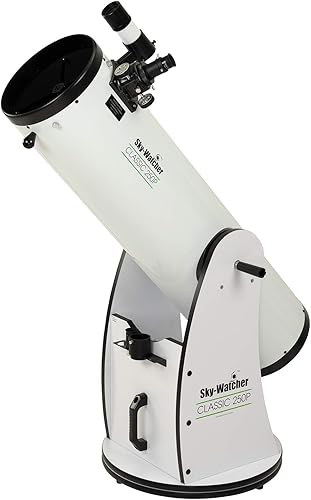 Best for more aperture
Sky Watcher Sky-Watcher Classic 250 Dobsonian 10-inch
8 inch vs 10 inch telescope: what changes in the view?
A 10-inch telescope gathers more light, while an 8-inch telescope can still show a wide range of deep-sky objects. The gain matters most when you observe faint targets under dark skies.
Mirror area rises with the square of aperture. A 10-inch mirror has 100 square inches of area and an 8-inch mirror has 64, so the 10-inch gathers about 1.56 times as much light before accounting for optical losses.
That does not translate into a 56% larger image or a view that looks 56% brighter to your eye. Magnification, eyepiece choice, atmospheric steadiness, light pollution and your eyes all affect the view.
What can the extra aperture help you see?
The larger mirror can make some faint galaxies, nebulae and star clusters easier to detect. It may also show more structure in a target, provided the sky is dark and the atmosphere is steady.
Aperture cannot remove light pollution or poor seeing. Under a bright suburban sky, moving to a darker location may improve views more than moving from 8 to 10 inches.
The 8-inch scope remains capable for visual observing. If convenience means you take it outside more often, that extra observing time may matter more than the larger mirror.
What stays similar between these two Dobsonians?
Both Sky-Watcher models have a 1200 mm focal length and come with 25 mm and 10 mm eyepieces. Both use a Dobsonian altazimuth mount, so the basic motion is up-down and left-right.
The two instruments therefore make a useful size comparison: aperture and physical handling are the clearest differences. The 8-inch Flextube also has a collapsible tube, while the 10-inch Classic has a solid tube.
Which telescope is easier to carry and set up?
The 8-inch model is lighter and its tube collapses; the 10-inch model weighs more and has a solid tube. Consider the full route from storage to observing spot, not only the weight on paper.
The 8-inch Flextube weighs 40 pounds fully assembled, with a 24-pound tube and 26-pound base. The 10-inch Classic weighs 53 pounds assembled, with a 28-pound tube and 25-pound base.
Their sections are manageable for many people, but carrying a bulky tube through stairs or narrow doors can be harder than lifting the same weight in a compact shape. If you need to carry gear alone, plan to move the tube and base separately.
How does the collapsible 8-inch tube help?
The Flextube's struts let its optical tube collapse for storage and transit without taking the tube fully apart. Sky-Watcher says preset indentations place the optics in the same position when extended, helping maintain collimation.
That design reduces the tube's stored length, but it doesn't shrink the base. Check the storage footprint and the space needed to extend the tube before deciding it fits your closet or vehicle.
For more detail on the format and tradeoffs, read how to choose a 10 inch telescope. The right size depends on how you will transport and use it.
When does the 10-inch solid tube make sense?
Choose the Classic 250 when you can store and move its solid tube, and you want the larger mirror for visual observing. The assembled weight is 53 pounds, but its tube and base can be carried as separate pieces.
A solid tube avoids extending struts during setup. It also needs enough clearance in storage and in your vehicle, so measure the longest route and the storage spot rather than estimating.
If the 10-inch aperture fits your plans, compare best 10 inch aperture telescope options before settling on a specific model. If moving the scope is the deciding factor, start with best 8 inch telescope options.
How much storage space should you plan for?
Plan space for the tube, base and a clear path to remove both. The 8-inch collapsible design can reduce tube length, but either Dobsonian still needs room for its base.
The 10-inch Classic's listed dimensions are 49 inches deep, 27 inches wide and 20 inches high. Those measurements describe the assembled form, so measure the pieces and route you will actually use for storage and transport.
For the 8-inch Flextube, the important storage feature is its collapsible tube. Its product dimensions are 29.5 x 20 x 36 inches, but don't assume those describe every collapsed arrangement or the room needed around the base.
Mark out the floor area with tape, then check closet doors, shelves and vehicle openings. Include space to grip and turn the tube, not just the exact dimensions of the scope.
Which size is better for beginners?
An 8-inch scope is often easier to manage, while a 10-inch can suit a beginner with adequate storage and help moving it. Neither aperture is automatically too advanced if you are comfortable learning the mount and locating targets.
Both models include two eyepieces and a finder scope, which gives you basic equipment for getting started. The 8-inch includes an 8x50 right-angle finder, while the 10-inch includes a 9x50 straight-through finder.
A Dobsonian is a manual mount, so you'll point the telescope by hand and learn to track objects as Earth turns. If you are comparing a smaller scope too, our guide to whether an 8 inch telescope is good for beginners covers the learning curve and tradeoffs.
Is the 10-inch upgrade worth the extra weight?
It can be worth it if faint deep-sky viewing is a priority and the extra 13 pounds assembled won't keep you from observing. The tube itself is only 4 pounds heavier than the 8-inch tube, but the base and overall package still need space.
Consider how often you can reach a dark observing site and whether another person can help with transport. If the scope will live near the observing area, the weight may matter less than it would in an apartment with stairs.
For a computerized alternative in a different size and design, see our guide to the Sky-Watcher Virtuoso GTi. It helps compare a compact tracking option with a manual Dobsonian.
Which telescope should you choose for your observing style?
Choose by the observing you expect to do and the effort you can repeat each session. A larger aperture helps only when you can get the scope to a useful spot and set it up comfortably.
Pick the 8-inch if you want a balance of aperture and easier transport. Its collapsible tube is useful when storage length is tight, and its 40-pound assembled weight is lower than the 10-inch's.
Pick the 10-inch if your main goal is to gather more light for visual deep-sky observing and you have room for a solid tube. It weighs 53 pounds assembled, so include lifting and route planning in the decision.
If your goals include astrophotography or advanced observing, aperture is only one part of the setup. Our guide to professional telescopes for astronomy explains how mount, optics and imaging needs affect that choice, while SVBONY SV48P vs SV503 compares two refractors for a different style of observing.
Which 8-inch and 10-inch Dobsonians fit these needs?
The Flextube 200 is the more portable choice here, and the Classic 250 is the higher-aperture choice. Their shared 1200 mm focal length and included eyepieces keep the comparison focused on aperture, weight and storage.
What is the final 8 inch vs 10 inch telescope choice?
Choose 8 inches if transport and storage will decide how often you observe; choose 10 inches if you can manage the size and want more light gathering. For many home observers, a scope that is easy to bring outside is the one that gets used.
The Sky-Watcher Flextube 200 is the practical pick when a collapsible tube and lower assembled weight matter. The Sky-Watcher Classic 250 is the aperture pick when you have room for its solid tube and want the larger mirror for faint targets.
If both choices seem manageable, base your decision on the darkest site you can reach and the amount of storage space you have. Then compare the best 8-inch telescopes or best 10-inch telescopes for the format that fits your routine.
Frequently asked questions
How much more can you see with a 10-inch telescope?
A 10-inch telescope gathers about 56% more light than an 8-inch telescope, based on the ratio of their mirror areas. That can help reveal fainter deep-sky detail under the same sky, but seeing, darkness, optics and observing skill also affect what you can make out.
Is an 8-inch telescope enough for deep-sky viewing?
Yes. An 8-inch telescope can show many star clusters, nebulae and galaxies, especially under dark skies.
A 10-inch may reveal fainter targets or more detail, but a portable 8-inch that you use often can be a better fit than a larger scope that stays stored.
Is a 10-inch telescope too heavy for one person?
It depends on the scope design, your strength and the route from storage to observing spot. The 10-inch Sky-Watcher weighs 53 pounds assembled, while its tube and base weigh 28 and 25 pounds.
Plan to carry those sections separately and check doorways, stairs and vehicle space.
Does a 10-inch telescope need more storage space?
Usually, yes, especially when comparing a solid tube with a collapsible design. The 10-inch Sky-Watcher has a solid tube, while the 8-inch Flextube collapses for storage and transit.
Measure the tube, base and the space needed to move each part before choosing.
Should a beginner choose an 8-inch or 10-inch telescope?
Either can suit a beginner who wants visual astronomy and is ready to learn a Dobsonian mount. Choose 8 inches if moving and storing the scope are major concerns; choose 10 inches if you have room and can manage its extra weight.
See our guide to what size telescope is good for beginners.