7 Best Telescopes for 7-Year-Olds (October 2026)
The best telescopes for children about 7 years old include the Gskyer Telescope for a first backyard refractor, the Blue Marble NASA Lunar Telescope for Kids Ages for Moon-focused sessions, and the Koolpte Telescope for Kids for family viewing and phone sharing.
On this page (5 sections)
The best telescope for a 7 year old is a simple, steady model the child can use with an adult, with the Moon as an easy first target. Our top pick is the Gskyer Telescope, while a tabletop scope can suit shorter sessions and the LeapFrog offers screen-based activities.
At this age, the observing experience matters as much as magnification. A child may enjoy finding the Moon, taking turns at the eyepiece and keeping a short observation journal more than working through a complicated setup.
For a broader checklist on choosing a child-friendly scope, see How Do I Pick a Telescope for My Kid? What to Know.
If the child is closer to preschool age, our guide to the best telescope for a 4 year old covers simpler ways to share the sky.
Our picks at a glance
-
1
-
2
 Best for Moon-focused sessions
Blue Marble NASA Lunar Telescope for Kids Ages
9.4/10 our score
See it on Amazon -
3

- 4
 Best for trying more eyepiece optionsCheck it
- 5
 Check it
Hawkko 80mm Aperture 500mm Telescope for Kids
Best for a larger aperture - 6
 Check it
LeapFrog Magic Adventures Telescope
Best for screen-based space activities - 7
 Check it
Educational Insights GeoSafari Starview Telescope
Best for simple tabletop practice
Which telescope is best for a 7-year-old?
The Gskyer Telescope is the best all-around choice for a 7-year-old who is ready to explore a traditional refractor with adult help. Its 70 mm aperture, adjustable tripod and carry bag make it a flexible starting point for family viewing.
The picks below cover different levels of involvement, from a tabletop telescope to a digital screen model. The included score reflects how well each telescope’s features match an early school-age child and family use; our score weighs specs, features and buyer feedback against what you’re shopping for.
| Product | Best for | Aperture | Focal length | Mount | Our score |
|---|---|---|---|---|---|
| Gskyer Telescope | a first backyard refractor | 70 mm | 400 mm | Altazimuth | 9.7 |
| Blue Marble NASA Lunar Telescope for Kids Ages | Moon-focused sessions | 9.4 | |||
| Koolpte Telescope for Kids | family viewing and phone sharing | 70 mm | 500 mm | Altazimuth | 9.3 |
| Koolpte Telescope for Kids | trying more eyepiece options | 70 mm | 400 mm | 9.2 | |
| Hawkko 80mm Aperture 500mm Telescope for Kids | a larger aperture | 80 mm | 500 mm | Altazimuth | 8.9 |
| LeapFrog Magic Adventures Telescope | screen-based space activities | 8.8 | |||
| Educational Insights GeoSafari Starview Telescope | simple tabletop practice | 8.2 |
What are the best telescopes for children about 7 years old?
These telescopes suit different interests, so choose by how much setup a child can manage and what they want to see. A seven-year-old may need an adult to find the target, adjust focus and keep the tripod steady.
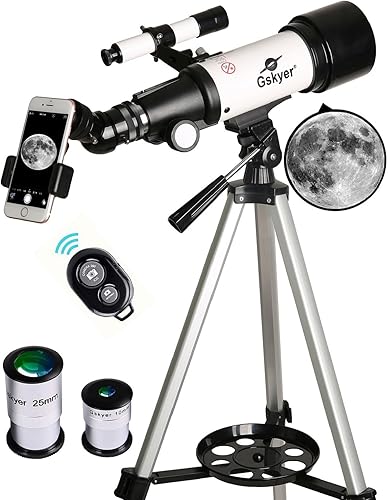
Gskyer Telescope: Best for a first backyard refractor
- 70 mm aperture
- 400 mm focal length
- Adjustable aluminum tripod
- Carry bag, phone adapter and wireless remote
A full-size refractor with an adjustable tripod gives a child room to grow into basic sky viewing. The carry bag and phone adapter add flexibility for family outings.
Pros
- Adjustable tripod
- Carry bag for storage and travel
- Two eyepieces and a 3x Barlow lens
Cons
- An adult will likely need to help with setup and aiming
- Tripod requires a steady surface
The Gskyer is a traditional refractor with a 70 mm aperture and 400 mm focal length. It includes two replaceable eyepieces and a 3x Barlow lens, so an adult can help a child begin with a wider, easier-to-find view before trying more magnification.
Its adjustable aluminum tripod offers different viewing positions, and the carry bag can hold the telescope and tripod for storage or travel. The 5x24 finder scope has cross-hair lines to help locate a target, though a child will likely need help aligning it.
The phone adapter and wireless remote give families another way to share an observing session. Treat phone photography as an optional activity, since centering a target through a telescope can take patience.
Choose it for a family that wants a traditional first refractor and can help with setup. For a child interested in planets, see telescopes for kids to see planets.
Begin with the Moon and a low-power eyepiece, then move to higher power only after the target is centered.
Blue Marble NASA Lunar Telescope for Kids Ages: Best for Moon-focused sessions
- Tabletop tripod
- Low- and high-power eyepieces
- Finder scope
- Learning guide
A tabletop setup and Moon-centered learning guide make this a focused choice for children who want to explore lunar features with an adult.
Pros
- Tabletop tripod
- Finder scope for locating the Moon
- Includes a learning guide
Cons
- Its stated age range begins at 8 years
- Focused on lunar viewing
The Blue Marble NASA Lunar Telescope is built around Moon viewing, with a tabletop tripod, finder scope and low- and high-power eyepieces. Its smooth mount system is intended to help scan across the lunar surface.
The tabletop format keeps the setup compact and places the controls within easy reach when the telescope rests on a stable table. A learning guide adds Moon facts and instructions for shared sessions.
One detail matters for a seven-year-old: its stated age range is 8 years and up. A younger child can still observe with an adult, but the age label makes this a better fit if the child is close to eight and especially interested in the Moon.
For a child who wants more than lunar viewing, compare it with our guide to best telescope for kids 8-12.
Koolpte Telescope for Kids: Best for family viewing and phone sharing
- 70 mm aperture
- 500 mm focal length
- Adjustable aluminum tripod
- Phone adapter, remote and carrying case
This refractor includes a phone adapter and wireless remote, which can help families share a view or try simple phone photos together.
Pros
- Two eyepieces and a 3x Barlow lens
- Phone adapter and wireless remote
- Carrying case
Cons
- A 7-year-old may need help aligning the finder scope
- Tripod setup adds steps
This Koolpte refractor has a 70 mm aperture and 500 mm focal length, plus two eyepieces and a 3x Barlow lens. Its 5x24 finder scope can help an adult guide a child toward the Moon or a distant daytime target.
The adjustable aluminum tripod, carrying case, phone adapter and wireless remote give families options for backyard use and travel. The child can take turns viewing while an adult handles the setup and helps keep the scope pointed at the target.
The added focal length and accessories may appeal to families who expect to keep using the telescope as the child grows. The extra parts also mean more pieces to keep track of after a session.
Choose this model if sharing views and trying phone photos are part of the fun. For a simpler setup, a tabletop option may take less space and require fewer adjustments.
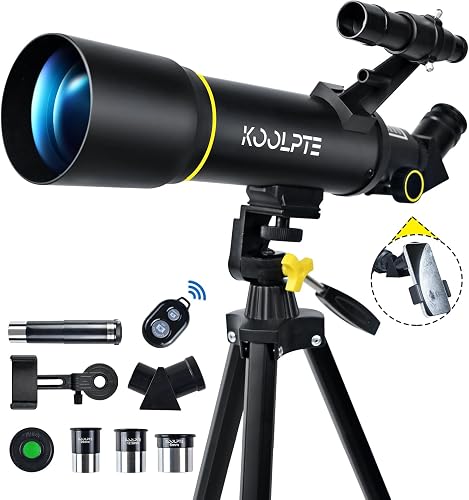
Koolpte Telescope for Kids: Best for trying more eyepiece options
- 70 mm aperture
- 400 mm focal length
- Three eyepieces
- Phone adapter and wireless remote
Three eyepieces give families more options for comparing views, while the adjustable tripod and wireless remote support shared observing.
Pros
- Three eyepieces and a 3x Barlow lens
- Phone adapter and remote
- Adjustable aluminum tripod
Cons
- Several eyepiece choices may take adult guidance
- No carry bag is specified in the included features
This second Koolpte telescope has a 70 mm aperture and 400 mm focal length, with three eyepieces and a 3x Barlow lens. That range gives an adult several combinations to introduce gradually, but a seven-year-old may find it easier to start with one low-power option.
The kit includes an adjustable aluminum tripod, phone adapter and wireless remote. Its 400 mm focal length and travel design make it a compact refractor for family sessions.
More eyepieces can help a child compare views over time, though swapping them and refocusing can interrupt a short session. Keep the other eyepieces put away until the child is comfortable with basic aiming and focus.
Pick it when you want several eyepiece options and expect to guide the child through each change. If a child prefers a learning activity over setup, the LeapFrog may hold attention in a different way.
Hawkko 80mm Aperture 500mm Telescope for Kids: Best for a larger aperture
- 80 mm aperture
- 500 mm focal length
- Two eyepieces and 3x Barlow lens
- Adjustable tripod and phone adapter
Its 80 mm aperture is larger than the 70 mm models here, and the kit includes space stickers that a child can use to personalize the telescope.
Pros
- Largest stated aperture in this roundup
- Includes space-themed stickers
- Phone adapter and adjustable tripod
Cons
- Designed for ages 8–12 and adults who are beginners
- An adult may need to guide setup and eyepiece changes
The Hawkko has an 80 mm aperture and 500 mm focal length, with two eyepieces and a 3x Barlow lens. It also includes an adjustable tripod, phone adapter and space-themed stickers for personalizing the telescope.
Its larger aperture may interest families comparing light-gathering size, but the model is described for ages 8–12 and adults who are beginners. For a seven-year-old, plan on adult help with setup, target finding and changing eyepieces.
Hawkko describes this model as portable and says setup takes minutes with the instruction manual. An adult should still assemble and check the tripod before inviting a child to look through it.
Consider the Hawkko if an older sibling will also use the telescope or the child is nearly eight and comfortable with guided activities. For a younger child who wants a more self-contained experience, the digital LeapFrog is intended for ages 5 and up.
LeapFrog Magic Adventures Telescope: Best for screen-based space activities
- 2.4 in video screen
- Up to 110x zoom
- 100+ NASA videos and images
- 20 Cosmic Cards
A built-in screen, saved pictures and space activities make this a different kind of first telescope for a child who enjoys interactive learning.
Pros
- Intended for ages 5 and up
- Includes NASA and ESA videos and images
- Comes with 20 Cosmic Cards
Cons
- Requires 4 AA batteries for regular use
- Digital screen experience differs from looking through an eyepiece
The LeapFrog Magic Adventures Telescope uses a 2.4 in video screen for viewing, then adds space videos, images and a spacecraft game. It is intended for ages 5 and up, so the age fit is direct for a seven-year-old.
The telescope offers up to 110x zoom and can capture and save pictures. Twenty Cosmic Cards add short facts about space objects, while the videos and images cover topics such as the Moon, constellations and star life cycles.
This is a screen-based activity rather than a standard eyepiece-first refractor. It requires 4 AA batteries, and new batteries are recommended for regular use because the included batteries are for demonstration.
Choose LeapFrog for a child who likes interactive learning and a built-in display. Choose a traditional refractor if the goal is to practice focusing and looking through an eyepiece.
Educational Insights GeoSafari Starview Telescope: Best for simple tabletop practice
- Tabletop tripod
- 10x and 50x eyepieces
- Activity journal
- Portable for indoor and outdoor use
A tabletop tripod and activity journal support short learning sessions, with eyepieces for practicing lower- and higher-power viewing.
Pros
- Tabletop tripod
- Activity journal included
- Can be used for nature viewing as well as sky viewing
Cons
- A 7-year-old may need help locating and focusing on targets
- The stated magnifications are lower than several refractors here
The GeoSafari Starview is a compact telescope with a tabletop tripod, two lenses labeled 10x and 50x, and an activity journal. A stable table can make the setup easier for a child to approach than a full-height tripod.
The journal offers simple projects and ideas for stargazing, and the telescope is also described for viewing birds, animals and nature. That gives families daytime activities while waiting for a clear night.
The child may still need help pointing the telescope and adjusting the view. Begin with the lower magnification and a nearby daytime target, then try the Moon with adult guidance.
Pick it if a tabletop telescope and activity journal suit your child’s attention span. For more age-specific options as children get older, see best telescope for 8 year old.
What makes a telescope manageable at age 7?
A manageable telescope has a steady base, simple controls and a target that is easy to find with help. For many families, a low-power view of the Moon is a better first step than choosing the largest magnification number.
A tabletop tripod can reduce the number of parts a child must handle, while an adjustable tripod allows a family to change the viewing height. Either way, set the telescope on firm ground or a sturdy table and let an adult make the first adjustments.
A finder scope helps locate a target, but it needs to point in the same direction as the main telescope. An adult can align it during setup, then help the child move the telescope slowly until the target appears in the eyepiece.
If a child likes activities, a learning guide or cards can add structure between observations. Our guide to the best telescope kit for kids compares telescope sets with learning materials and other accessories.
How can you make a first stargazing session easier?
A short session with one clear target gives a child more time to enjoy observing and less time waiting for setup. The Moon is often a practical first target because it is bright and easy to recognize.
Set up while there is still enough light to see the tripod and controls. Let an adult focus and center the view, then invite the child to look and describe what they notice before changing eyepieces.
Choose a night when the sky is clear and the Moon is above the horizon at a convenient time. Use our guide to the best time for stargazing to plan around darkness, weather and the Moon’s position.
Keep the telescope away from direct sunlight. Never aim a telescope at the Sun, even briefly, because the concentrated light can cause severe eye injury.
Which telescope should you choose for your child?
Choose the Gskyer if you want a traditional refractor with an adjustable tripod and carry bag, and you can help a child set it up. Choose the Blue Marble for a Moon-centered tabletop experience, bearing in mind its stated age range starts at eight.
Choose the LeapFrog if your seven-year-old prefers a screen, saved pictures and space activities. For a small tabletop setup and journal, consider the GeoSafari Starview; for a larger aperture and older sibling use, consider the Hawkko.
The right first telescope is the one your family will set up and use together. Start with one target, keep the first session short, and add more eyepiece options as the child gains confidence.
Our top 3 picks at a glance
-
1
-
2
Best for Moon-focused sessions
Blue Marble NASA Lunar Telescope for Kids Ages
9.4/10 our score
See it on Amazon -
3
Frequently asked questions
Can a 7-year-old use a telescope alone?
A 7-year-old can take part in observing, but an adult should help set up the tripod, find targets and handle small eyepieces. Start with the Moon, use the lowest-power eyepiece and let the child take turns looking after the view is centered.
Never point a telescope at the Sun.
What should a first telescope for a 7-year-old include?
Look for a steady, manageable setup, simple aiming and a low-power eyepiece for finding the target. A tabletop tripod can be easier to handle than a taller tripod, while a finder scope can help when an adult guides the child through locating the Moon.
Keep the first sessions short and focused.
Is a digital telescope a good choice for a 7-year-old?
A digital telescope can suit a child who likes screens, saved pictures and guided activities. The LeapFrog Magic Adventures Telescope has a 2.4 in video screen and space videos and images.
A traditional refractor offers a direct eyepiece view and gives you practice with focusing and aiming.
Are telescopes for kids ages 5–7 different from beginner telescopes?
Telescopes marketed for ages 5–7 often emphasize simple setup or interactive activities, while beginner refractors may include more eyepieces and adjustments. Either can work with adult help, so choose based on the child’s patience, interest and comfort with an involved setup.
Age labels alone don’t tell you how easy a telescope will feel.