Dobsonian vs Newtonian Telescope: What Is the Difference? (October 2026)
A Dobsonian is a mount style, while a Newtonian is an optical design. Many Dobsonian telescopes use Newtonian optics, so the terms describe different parts of the same telescope.
On this page (7 sections)
- What is the difference between a Dobsonian and a Newtonian telescope?
- How do the mount and optics work together?
- Which setup is easier to use?
- What should you compare before choosing?
- Do both telescope types need collimation?
- Which products show the difference in practice?
- Which should you choose, Dobsonian or Newtonian?
A Dobsonian telescope vs Newtonian comparison is really about a mount style versus an optical design. Many Dobsonian telescopes use Newtonian reflector optics, so the two terms can describe different parts of one telescope.
The practical choice is often between complete setups: a Newtonian reflector on a tabletop Dobsonian base, or a Newtonian on a tripod mount. The mount affects how you support and point the tube; the optical design affects how the telescope gathers and directs light.
We compared the supplied product features to show how those choices fit together.
 Best for a compact Dobsonian
Sky-Watcher Sky-Watcher Heritage 130mm Tabletop Dobsonian 5-inch
 Best for app guided aiming
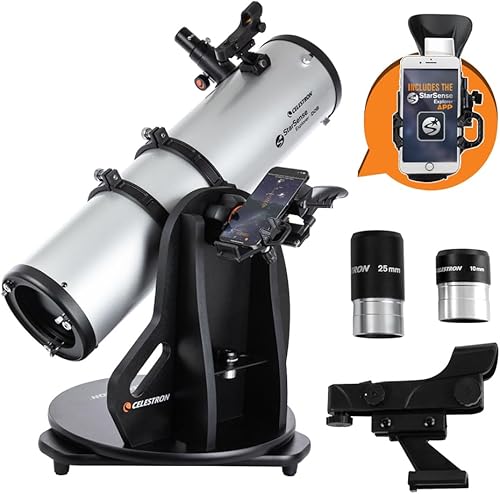
Celestron StarSense Explorer 150mm App-Enabled Tabletop Dobsonian
What is the difference between a Dobsonian and a Newtonian telescope?
Dobsonian refers to the mount, while Newtonian refers to the telescope's mirror based optical design. A telescope can be both at once.
A Newtonian reflector uses a primary mirror at the bottom of its tube and a smaller diagonal mirror near the front. That diagonal redirects light toward an eyepiece on the side of the tube.
Read more about what a reflecting telescope is.
A Dobsonian mount is a simple altazimuth support. It lets you move the telescope up and down and from side to side, usually by pushing the tube by hand.
That distinction clears up the common search phrase “is a Dobsonian telescope a Newtonian?” It often is, but Dobsonian doesn't name the optical design, and Newtonian doesn't specify the mount.
How do the mount and optics work together?
The mount holds and points the tube; the Newtonian optics form the view. A Dobsonian base is one way to support a Newtonian telescope.
In a Dobsonian setup, the tube rests in a base that moves horizontally and vertically. The design is usually straightforward to use, though the observer still aims and tracks targets by hand.
A Newtonian reflector can also sit on a tripod mount. The Celestron StarSense Explorer LT 114AZ, for example, combines Newtonian optics with a manual altazimuth tripod mount, rather than a Dobsonian base.
For a closer look at how the base and mirrors work together, see how a Dobsonian telescope works.
The mount style is only one part of the full setup, alongside tube size, eyepieces, finder and observing location.
Which setup is easier to use?
A Dobsonian base offers simple hand movement, while a tripod Newtonian may suit you if you prefer a raised setup. Ease also depends on the telescope's size, height and aiming aids.
A tabletop Dobsonian needs a sturdy, level surface at a comfortable height. It can be easy to move as a compact package, but you need to bring a table or find a suitable platform.
A tripod Newtonian stands independently and can be set up where there isn't a table. Its controls vary by model, so check whether the mount moves smoothly and whether the eyepiece lands at a comfortable height.
App guidance can help with finding objects, but it doesn't change the mount or optical design. The Celestron StarSense Explorer 150mm combines a Newtonian reflector and tabletop Dobsonian base with a smartphone dock that provides on-screen arrows to targets.
If you're choosing your first tabletop setup, consider whether a tabletop telescope is good for beginners and whether you'll have a stable surface ready at each observing spot.
Is a Dobsonian a good choice for beginners?
A Dobsonian can be a good beginner choice if you want a simple manual mount and a reflector tube. Its basic up, down and side to side movement is easy to understand, but you still need to learn how to locate and follow objects.
A larger base and tube can be less convenient to carry than a small tabletop model. Review whether a Dobsonian telescope is good for beginners with your storage space, transport needs and observing habits in mind.
What should you compare before choosing?
Compare the full telescope, including its mount, optical tube, height, portability and included accessories. The word “Newtonian” alone doesn't tell you how the whole setup will feel to use.
A tabletop Dobsonian combines the base and tube in a compact package, but needs a firm surface. A tripod mounted Newtonian stands on its own, and the mount may take up more space when assembled.
Check what comes in the box, too. Eyepieces and a finder help you start observing, while a phone dock can add aiming support on compatible models.
If you're comparing reflector designs with another common optical type, this Newtonian telescope vs refractor guide explains the difference between those optical designs. It won't answer the mount question by itself, since either design can be paired with different supports.
Do both telescope types need collimation?
Newtonian reflectors may need collimation, regardless of whether they sit on a Dobsonian base or a tripod. Collimation aligns the mirrors so the optical path is centered.
A mount doesn't determine whether the mirrors need alignment. Handling and transport can affect alignment, so learn the correct check and adjustment steps for the model you own.
The guide to collimating a Newtonian telescope covers the process. A collimation tool is an optional aid, not a replacement for understanding the procedure.
Which products show the difference in practice?
The products below pair Newtonian reflector optics with different supports or aiming features. They illustrate why comparing the full setup gives a clearer answer than choosing by one label.
The Sky-Watcher Heritage 130mm combines a tabletop Dobsonian base and a Newtonian reflector tube. It comes fully assembled with 10mm and 25mm eyepieces and a starpointer finderscope.
The Celestron StarSense Explorer 150mm is another tabletop Dobsonian and Newtonian pairing. Its app uses on-screen arrows to guide aiming, and the telescope includes 10mm and 25mm eyepieces.
The Celestron StarSense Explorer LT 114AZ has Newtonian optics on a tripod mounted altazimuth mount. It includes a full-height tripod, two eyepieces, a 2x Barlow lens and a StarSense smartphone dock.
Which should you choose, Dobsonian or Newtonian?
Choose by the mount you want and the optical tube that fits your needs. Pick a Dobsonian setup for simple manual movement, especially if you want a tabletop model; pick a Newtonian on a tripod if you prefer a self standing support.
These choices aren't opposites. The tabletop Sky-Watcher and Celestron StarSense Explorer 150mm both pair Dobsonian mounts with Newtonian reflectors, while the StarSense Explorer LT 114AZ pairs Newtonian optics with a tripod mount.
Think of “Dobsonian” as the support and “Newtonian” as the optics. That distinction makes the comparison clear and helps you choose a complete telescope that fits your space and observing style.
Frequently asked questions
Is a Dobsonian telescope a Newtonian?
Often, yes. Dobsonian describes the mount style, and Newtonian describes an optical design that uses mirrors.
Many Dobsonian telescopes pair a Newtonian reflector tube with a simple altazimuth base, but the words don't mean the same thing.
Is a Newtonian telescope always a Dobsonian?
No. A Newtonian reflector can sit on a Dobsonian base, an equatorial mount or another compatible mount.
The optical design stays Newtonian while the support and way you point the telescope change.
Which is easier for a beginner, Dobsonian or Newtonian?
The terms alone don't decide ease of use because they describe different parts. A manual Dobsonian base moves simply by hand, while a Newtonian on a tripod may have different controls.
Compare the complete telescope, its height and how you plan to aim it.
Do Newtonian telescopes need collimation?
Newtonian reflectors may need mirror alignment, called collimation, to keep the optical path lined up. How often depends on the telescope and how it is handled.
Learn the steps for your model before adjusting anything.
Can you build a Dobsonian telescope?
Yes, a Dobsonian base can be built as a project, but the optical tube and mirror alignment still need careful planning. A build guide can help you understand the parts and measurements before choosing materials.