How Do Image Stabilized Binoculars Work?
Image stabilized binoculars use a powered stabilization system to detect and reduce small hand movements. The result is a steadier view at higher magnification, especially for astronomy, wildlife, and marine observing.
On this page (10 sections)
- How do image stabilized binoculars work?
- What happens inside an image stabilized binocular?
- Why does stabilization help at high magnification?
- What is the difference between 10x, 15x, and objective size?
- Does image stabilization make binoculars easier to use?
- What are the main types of image stabilization?
- Are image stabilized binoculars worth it for astronomy?
- What should you check before buying?
- How should you use and care for image stabilized binoculars?
- What is the simplest way to understand image stabilized binoculars?
Image stabilized binoculars use a powered optical system to reduce small hand movements, giving you a steadier view than ordinary handheld binoculars. The benefit is most noticeable at higher magnification, where even a small tremor can make the Moon, birds, boats, or stars jump across the view.
The basic trade-off is simple: you gain a calmer image, but the binoculars may weigh more, cost more, and need batteries. Understanding the mechanism helps you decide if that trade-off fits your observing style.
How do image stabilized binoculars work?
Image stabilized binoculars detect small movements and shift optical elements to keep the image steadier. A sensor detects movement, a control system calculates a correction, and a powered mechanism moves a lens group or prism in the opposite direction.
The correction happens while you view. It cannot make the binoculars motionless or correct large movements such as walking or a sudden change in aim.
Ordinary binoculars magnify hand movement too. At 10x, small shake appears about 10 times more noticeable, and higher magnification makes steady holding harder.
Stabilization reduces that movement, so fine detail is easier to inspect and targets stay in view longer. Canon's image stabilization explanation gives useful background.
What happens inside an image stabilized binocular?
The key parts are motion sensors, a control circuit, and a moving optical element. The sensors detect changes in angle, the circuit works out the correction, and the optical system shifts to offset that movement.
Optical image stabilization
Optical stabilization moves a lens group or another optical component. The correction takes place before the image reaches your eyes, so the view remains optically corrected rather than being digitally cropped or processed like a video frame.
This design can work well for handheld astronomy because it preserves a direct optical view. The system still needs power, and the moving parts add complexity compared with a standard binocular.
Lens-shift image stabilization
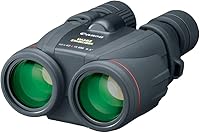
Lens-shift stabilization moves part of the lens assembly to counter hand movement. The Canon Cameras US 10X32 is Image Stabilizing Binocular uses lens-shift image stabilization and includes Normal and Powered IS modes.
The 10X32 model has a 10x maximum magnification, a 32 mm class objective indicated by its model name, a 3.2 mm exit pupil, and a 1.7 lb weight. Its center focus, wide-range diopter adjustment, and fold-down rubber eyecups support basic setup for shared viewing.
Choose this type if you want a lighter option among these 3 products and prefer a simple 2-button interface. Its 1.7 lb weight is easier to carry than the heavier models here, but a smaller objective generally gathers less light than a 42 mm or 50 mm design.
Why does stabilization help at high magnification?
Higher magnification makes hand movement more visible, so stabilization can make a 10x or 15x view easier to hold. Without correction, a target can drift or vibrate even when your hands feel still.
This matters for astronomy because many targets are small, dim, or detailed. The Moon is easy to find with ordinary binoculars, but craters and sharp edges are more satisfying when the view is not constantly moving.
A stabilized view also helps follow a bird, inspect a distant boat, or watch a moving object without repeatedly lowering the binoculars to regain your aim.
Stabilization does not increase true optical resolution by itself. It helps you use the optics you already have by reducing motion blur and view shake.
For more on magnification, see How Does a Telescope Magnify Images? A Simple Guide.
What is the difference between 10x, 15x, and objective size?
Magnification controls how large the subject appears, while objective size affects light gathering and exit pupil. The first number in a binocular name usually identifies magnification.
The second commonly identifies objective diameter in millimeters.
A larger objective can support a brighter view, especially when the exit pupil remains useful in low light. It also adds size and weight, which may increase the value of stabilization.
The Canon 4625A002 15x50 is Image Stabilized Binocular combines 15x magnification with a 50 mm objective. Read the Canon 15x50 IS binoculars review for more on this model.
It has a 3.3 mm exit pupil, 15 mm eye relief, and weighs 2.6 lb.
This model suits someone who wants the highest magnification and largest objective among these 3 choices. Its Optical Image Stabilizer is designed to compensate for hand shake and minute vibrations at the touch of a button.
The trade-off is handling. At 2.6 lb, it asks more from your arms than the 10X32 model, so use a supported seated position for longer sessions.
Its 15 mm eye relief may help viewers who need more space between their eyes and the eyepieces.
If you are still deciding what binoculars to buy, compare magnification, objective size, exit pupil, eye relief, weight, focus controls, and stabilization together.
Does image stabilization make binoculars easier to use?
Image stabilization makes the view easier to hold, but it does not remove the need for correct setup. Adjust the interpupillary distance and focus each side before turning stabilization on.
Start by adjusting the eyepieces so the 2 circular views merge into 1. If the binoculars have a diopter adjustment, use it to balance differences between your eyes.
Hold the binoculars near the center of their weight. Rest your elbows against your body or a stable surface, and use a chair for long sessions.
Press the stabilization control after aiming, give it a moment to settle, then follow the target slowly.
The Canon 10x42 L is WP Image Stabilized Binoculars provide 10x magnification, a 42 mm objective indicated by the model name, a 4.2 mm exit pupil, 16 mm eye relief, center focus, and weigh 2.4 lb.
This model fits observers who want a balance between 10x magnification and a larger objective than the 10X32. Its features include image stabilization, fog proofing, waterproof construction, low-light technology, and ultra-low-dispersion lead-free glass.
It also comes with a padded case with strap, neoprene strap, eyepiece rainguard, 1-piece push-on objectives cap, and 2 1.5-volt AA alkaline batteries. Those included items make it easier to prepare for a session, while the 2.4 lb weight still calls for a steady grip.
For more detail on this model, read the Canon 10x42L IS WP Binoculars Review.
What are the main types of image stabilization?
The main practical difference is how the binocular moves its optics to counter motion. Some systems shift lens elements, while others use a different optical correction path controlled by sensors and electronics.
You do not need to identify every internal component before buying. Focus on magnification, objective size, weight, eye relief, controls, and weather protection that match your use.
A stabilization system can also have more than one mode. A normal mode handles routine hand movement, while a powered mode applies a stronger correction for a more demanding view.
Controls matter if you need to activate stabilization while wearing gloves or tracking a moving subject. A simple button layout is easier to use in the dark than many small controls.
The 10X32 model has Normal and Powered IS modes with a simple 2-button user interface. The 15X50 model uses a touch-of-a-button Optical Image Stabilizer, while the 10X42 L model includes image stabilization with center focus.
Are image stabilized binoculars worth it for astronomy?
They can be worth it if you want handheld views at 10x or higher without carrying a tripod. They are less compelling if you mainly observe from a fixed mount, prefer very light binoculars, or usually watch targets at low magnification.
For astronomy, compare the full system rather than stabilization alone. A 50 mm objective can support a bright field, but the binocular may be heavier.
A 32 mm objective is easier to carry, but may gather less light.
Stabilized binoculars work best when standing, walking, or moving between targets. A tripod can still be better for a long, fixed observation.
For astronomy-specific comparisons, see Best Image Stabilized Binoculars for Astronomy and Best Image Stabilized Binoculars. If you are comparing larger conventional binoculars, Best 12x50 Binoculars for the Money covers a different path to a bright, high-magnification view.
What should you check before buying?
Choose stabilization only after matching the binoculars to your hands, target, and observing time.
- Magnification: Pick 10x for a more manageable handheld view or 15x for more reach with extra weight.
- Objective size: A larger objective can support a brighter view, but usually increases size and weight.
- Exit pupil: Compare the exit pupil with your observing conditions and comfort needs.
- Eye relief: Longer eye relief can help you position your eyes comfortably.
- Weight: A stabilized binocular still needs to be held, so weight matters during long sessions.
- Power: Check the battery type and carry spares for extended observing.
- Weather protection: Near water or in damp conditions, look for waterproof or fog proof features.
- Controls: Choose buttons and focus controls you can operate without losing your target.
You can also compare Canon models in Best Canon Image Stabilized Binoculars. The right choice depends on whether you value high magnification, lower weight, a brighter objective, or waterproof construction most.
How should you use and care for image stabilized binoculars?
Use stabilization only when you need it, keep the optics clean, and protect the binoculars from impacts and moisture. Follow the model's controls and battery instructions, and switch the system off when you finish observing.
Hold the binoculars securely before pressing the stabilization button. Avoid shaking them to test the feature, and do not force the focus wheel or eyepiece adjustments.
Use a clean lens cloth for the optical surfaces. Brush away grit before wiping, because loose particles can scratch coatings.
Keep caps on the objectives and eyepieces when the binoculars are stored.
If the binoculars become damp, let them dry in a safe indoor place before storing them in a case. Do not use direct heat to dry the optics or body.
What is the simplest way to understand image stabilized binoculars?
Image stabilized binoculars are ordinary optical binoculars with a powered correction system that reduces hand movement. The most useful benefit is a steadier handheld view at higher magnification.
Choose the Canon 4625A002 15x50 is Image Stabilized Binocular if you want the most magnification and the largest objective here. Choose the Canon 10X32 model if lower weight and a simple interface matter most.
Choose the Canon 10x42 L model if you want a middle magnification, a brighter 42 mm class objective, and waterproof construction.
The best image stabilized binoculars are the ones whose weight, magnification, objective size, eye relief, and power needs fit how you actually observe.
Frequently asked questions
How do image stabilized binoculars work?
Image stabilized binoculars use sensors and a powered optical system to counter small movements from your hands. Depending on the design, the system shifts lens elements or adjusts another optical component so the view moves less.
You still need to hold the binoculars carefully, but fine shake becomes less distracting.
Are image stabilized binoculars good for astronomy?
Yes, image stabilized binoculars can suit astronomy because they reduce hand movement at useful magnifications. A steadier view can make the Moon, star fields, and brighter deep-sky targets easier to inspect.
Choose the objective size, magnification, weight, and eye relief together because stabilization does not remove the need for comfortable handling.
Do image stabilized binoculars need batteries?
Most powered image stabilized binoculars need batteries because the stabilization system uses electronic control and moving optical parts. Check the exact model before observing.
Carry suitable spare batteries, switch stabilization off when storing the binoculars, and remember that dead batteries leave you with ordinary unstabilized viewing.
Can image stabilized binoculars replace a tripod?
Image stabilized binoculars can reduce the need for a tripod during short handheld sessions, but they do not replace one in every situation. A tripod still helps for long observations, heavy binoculars, or a fixed view.
Stabilization is most useful when you want to stay mobile and observe without extra support.