What Can You See With a 70mm Telescope?
A 70mm telescope can show the Moon's craters, bright planets, double stars, and some bright star clusters and nebulae. Its view depends on the target, sky conditions, magnification, and how steady the telescope is.
On this page (8 sections)
- What can you see with a 70mm telescope in the Solar System?
- Can a 70mm telescope show star clusters and nebulae?
- How far can a 70mm telescope see?
- Does magnification change what a 70mm telescope can show?
- How can you get a clearer view from a 70mm telescope?
- Is a 70mm telescope good for beginners?
- Do accessories help a 70mm telescope?
- What should you expect from a 70mm telescope?
A 70mm telescope can show the Moon's craters, bright planets, double stars, and some bright star clusters and nebulae. What you see depends on the target, sky darkness, magnification, and how steady the telescope is.
Aperture is the diameter of the telescope's main lens or mirror. At 70mm, it gathers more light than your unaided eye, but faint deep-sky objects still look subdued, especially from a bright neighborhood.
What can you see with a 70mm telescope in the Solar System?
A 70mm telescope shows the Moon and several bright planets, with the Moon usually giving the clearest details. The planets look like small disks rather than bright points, but the amount of detail varies.
On the Moon, look for craters, mountains, and the changing boundary between day and night. That boundary, called the terminator, casts long shadows that make lunar features easier to see.
Venus can show phases, much like a tiny crescent Moon. Jupiter's four bright moons can appear as small dots nearby, and Saturn's rings may be visible when the planet is well placed.
Mars can look like a small reddish disk, but surface detail is difficult with a 70mm telescope. Its apparent size changes as it moves closer to or farther from Earth.
For a target-by-target overview, see what planets you can see with a telescope. A 70mm instrument's view through a telescope is also much smaller and dimmer than a photograph may suggest.
Can a 70mm telescope show star clusters and nebulae?
A 70mm telescope can show some bright star clusters and nebulae, but many deep-sky targets look faint and lack color. Dark skies make a bigger difference for these objects than extra magnification.
The Pleiades is a useful cluster to try because its bright stars spread across a wide area. The Beehive Cluster is another good target when it's visible in your sky.
Orion's Nebula can appear as a hazy patch around its brightest stars. Under dark skies, you may see more of its shape, but don't expect the vivid colors shown in long-exposure images.
Double stars are another good choice. Two stars close together can appear as separate points if the telescope is focused well and the air is steady.
Start with the brightest targets and use low magnification. If an object is hard to find, use a star chart or astronomy app to locate it before moving the telescope.
How far can a 70mm telescope see?
A 70mm telescope has no single practical distance limit; it can reveal nearby planets and much more distant stars. Whether you can see something depends more on its brightness, apparent size, the sky, and your view than on its distance alone.
For example, a star can be extremely far away and still appear as a point of light. A nearby galaxy may be harder to see because its light is spread over a wide area and can be washed out by city lights.
On land, a 70mm telescope may bring distant objects into view, but heat shimmer, haze, and the Earth's curved surface can limit what you can see. Read how far a telescope can see on land for more on terrestrial viewing.
The question of how far a telescope can see is best answered by the target and viewing conditions, not a maximum number of miles. A larger aperture, such as 300mm, gathers far more light for faint targets; see how far 300mm telescope vision reaches.
Does magnification change what a 70mm telescope can show?
Magnification makes a target look larger, but it doesn't add detail or light. Too much magnification can make the image dim, blurry, and harder to keep in view.
A 70mm telescope has a useful range that depends on its optics, eyepiece, focus, and the steadiness of the air. Begin with a low-power eyepiece to find the target, then try a moderate increase if the image stays sharp.
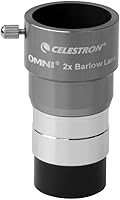
A 2X Barlow lens doubles the magnification of a compatible eyepiece. It can be useful when a bright target, such as the Moon or a planet, remains clear at higher power.
Use it only when the view remains sharp. If the image turns dim or soft, return to the lower magnification.
How can you get a clearer view from a 70mm telescope?
You can improve a 70mm telescope's view by choosing a bright target, using modest magnification, and letting your eyes adjust to darkness. A steady mount and careful focus also help you see the details the telescope can show.
- Set up away from streetlights and other bright sources when possible.
- Let the telescope adjust to the outdoor temperature.
- Start with a low-power eyepiece and focus slowly.
- Center the target, then try more magnification only if the image stays sharp.
- Give your eyes time to adjust before looking for faint objects.
The Moon is bright, so a telescope filter can reduce glare if the brightness bothers you. Don't look at the Sun through a telescope unless it has a proper solar filter securely fitted over the front opening.
A stable tripod matters because small shakes make a narrow view harder to hold. If your telescope came with an alt-azimuth mount, move it gently and pause after each adjustment.
Is a 70mm telescope good for beginners?
A 70mm telescope can suit beginners who want a simple way to explore the Moon, bright planets, and a few bright deep-sky targets. Its limits are part of the experience: faint objects show less detail, and high magnification doesn't guarantee a better view.
Before choosing one, check whether the mount feels stable, how the telescope focuses, and whether the eyepieces are easy to use. Our guide to whether a 70mm telescope is good for beginners covers the tradeoffs.
If you have a Lunarscope tabletop telescope, follow a setup routine that keeps the base steady and starts at low power. This guide explains how to use a Lunarscope tabletop telescope.
For a Celestron telescope with a computerized mount, alignment affects where it points, not how much detail its aperture can reveal. Follow the model's manual and our guide to how to align a Celestron telescope.
Do accessories help a 70mm telescope?
The most useful accessory depends on what makes observing uncomfortable or difficult. **A stable setup and the right eyepiece matter more than adding accessories for their own sake.
Keep eyepieces clean with careful eyepiece cleaning methods.**
A diagonal can make viewing through a refractor more comfortable, especially when the target is overhead. This Celestron 1.25-inch star diagonal has a 90-degree viewing angle and accepts standard 1.25-inch eyepieces.
A diagonal changes the viewing angle, not the telescope's aperture or light-gathering ability. Check that your telescope accepts a 1.25-inch diagonal before choosing one.
For a wide-field alternative, 15x70 binoculars can show star fields and bright clusters with both eyes. The Celestron SkyMaster includes a tripod adapter, and its size and weight make a tripod useful for extended viewing.
Binoculars aren't a telescope accessory, but they can help you scan broad areas of sky. A telescope is still the better fit when you want to focus on the Moon or a planet.
What should you expect from a 70mm telescope?
Expect clear lunar features, small planetary views, and a few bright deep-sky objects, with the darkest skies and steady setup giving you the best chance of seeing more. If your main goal is faint galaxies or detailed planetary views, a larger aperture may suit you better.
Choose bright targets first, keep magnification moderate, and give your eyes time to adjust. For the Moon and planets, focus on a crisp image rather than making the target as large as possible.
Frequently asked questions
What can you see with a 70mm telescope?
A 70mm telescope can show the Moon's craters, Jupiter's moons, Saturn's rings when they are favorably placed, bright double stars, and some bright clusters and nebulae. Views of faint objects are subtle, especially under light pollution, so choose bright targets and let your eyes adjust to the dark.
How far can you see with a 70mm telescope?
There isn't one useful distance limit for a 70mm telescope. It can show nearby Solar System objects in detail and much farther stars as points of light, but distance alone doesn't determine visibility; an object's brightness, size, sky darkness, and atmospheric conditions matter.
Can a 70mm telescope see planets?
Yes. A 70mm telescope can show Venus's phases, Jupiter's four bright moons, and Saturn's rings when the planet is well placed and the air is steady.
Planets look small, and extra magnification won't reveal detail if the atmosphere or the telescope's setup limits the view.
Can you see galaxies with a 70mm telescope?
Some bright galaxies may appear as faint smudges under a dark sky, but a 70mm telescope won't show the colorful, detailed views often seen in photographs. Start with brighter targets, use low magnification, and avoid observing when the Moon is bright.