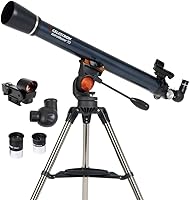
Celestron StarSense Explorer DX 5 Telescope Review: Worth It? (November 2026)
The Celestron StarSense Explorer DX 5 is a strong choice for smartphone-assisted backyard astronomy if you want compact Schmidt-Cassegrain optics and guided help finding targets. The DX 130AZ offers a wider field, while the DX 102AZ is a lighter refractor option.

On this page (10 sections)
- Celestron StarSense Explorer DX 5 review: the short answer
- What does StarSense Explorer do?
- The DX 5 optical design and daily viewing
- How does the DX 5 compare with the DX 130AZ?
- How does the DX 5 compare with the DX 102AZ?
- Which StarSense Explorer telescope should you buy?
- Setup advice for smartphone-assisted stargazing
- What should you check before buying?
- Care and observing habits
- Final verdict
The Celestron StarSense Explorer DX 5 is the best match here for guided Moon, planet and deep-sky viewing in a compact 5-inch telescope.
Its 130mm Schmidt-Cassegrain optical tube, 1250mm focal length and StarSense smartphone dock give you a focused setup for finding targets without relying only on a traditional finder.
That longer focal length suits close looks at the Moon and planets such as Jupiter and Saturn.
It also works for bright deep-sky objects like the Orion Nebula and the Andromeda Galaxy.
The StarBright XLT coatings are there to support sharp, vivid views through the 130mm optics.
The package includes 25mm and 10mm eyepieces, an erect image diagonal and a StarPointer finderscope.
The StarSense Explorer app uses sky recognition to analyze star patterns overhead and pinpoint the telescope position.
You dock your phone, launch the app and follow on-screen arrows until the bullseye turns green.
The app also generates a list of targets based on your time and location.
That takes much of the guesswork out of a first night under the sky.
The main trade-off is the manual mount.
StarSense helps you locate an object, but you still use the dual-axis slow-motion controls to keep it centered as the sky moves.
There is no automatic motorized tracking here, so regular small adjustments are part of the routine.
For a beginner or returning observer who wants guided finding in a compact Schmidt-Cassegrain, that trade-off is clear and manageable.
Celestron StarSense Explorer DX 5 review: the short answer
The DX 5 earns its 9.7 score because it combines the largest aperture in this comparison with smartphone-assisted sky recognition and a compact Schmidt-Cassegrain design.
It suits an adult beginner or returning observer who wants guided target finding and a focused view of planets, the Moon and bright deep-sky objects.
The 130mm aperture and 1250mm focal length give it a more focused view than the shorter focal length models in this group.
It is not the right choice if you want automatic motorized tracking.
The mount is manual, so the app points you toward a target but does not move the telescope for you.
You follow the arrows, check the eyepiece and then use the dual-axis slow-motion controls to stay on the object.
We compared the stated optical designs, aperture, focal length, field of view, mount style and included viewing tools.
Our score weighs specs, features and buyer feedback against what you are shopping for.
What does StarSense Explorer do?
StarSense Explorer turns a compatible smartphone into a sky-guidance tool. You dock the phone, launch the StarSense Explorer app and follow on-screen arrows toward a selected target.
The system uses sky recognition technology to analyze star patterns and calculate the telescope's position. The app can also create a list of suggested targets based on your time and location.
When the on-screen bullseye turns green, the telescope should be pointed at the selected object. You then look through the eyepiece and use the manual controls for small adjustments.
This is different from a telescope with automatic GoTo motors. The phone helps with finding, while your hands still control the altazimuth mount.
If you want to compare guided designs before choosing, our guide to the best telescope with app control covers the role of smartphone assistance in a larger buying decision.
The DX 5 optical design and daily viewing
The 130mm Schmidt-Cassegrain optical tube gives the DX 5 more light-gathering area than the 102mm model below. Its 1250mm focal length is suited to a more focused view, which can work well for the Moon and planets.
The DX 5 uses StarBright XLT coatings. Its stated field of view is 0.93 degrees, so large objects may not fit as easily as they do in the DX 130AZ's wider field.
The package includes 25mm and 10mm eyepieces, an erect image diagonal, a StarPointer finderscope and a StarSense Explorer phone dock. The mount and tripod are preassembled, and the telescope has an accessory tray.
The 25mm eyepiece gives a broader view than the 10mm eyepiece. The 10mm option gives higher magnification, but a narrower view can make finding and keeping an object centered more demanding.
The telescope uses manual focus. Take time to focus on a bright target before moving to dimmer objects, and adjust again when changing eyepieces.
How does the DX 5 compare with the DX 130AZ?
The DX 130AZ is the better choice for wider views, while the DX 5 is the better fit for a longer focal length and Schmidt-Cassegrain design. Both use 130mm-class optics and smartphone-assisted StarSense guidance.
The DX 130AZ is a Newtonian reflector with a 650mm focal length and a 2-degree field of view. That wider view can make large star fields, open clusters and broad nebulae easier to frame.
Its glass mirrors use aluminum and SiO₂ coatings. The package includes 25mm and 10mm eyepieces, an accessory tray, a preassembled mount and tripod, an optical tube and a StarPointer red dot finderscope.
The DX 130AZ weighs 18 lb, compared with 14.6 lb for the DX 5. That difference matters if you carry the telescope between storage and an observing spot.
The shorter focal length also changes the feel of the view. Choose the DX 130AZ when wider framing matters more than the DX 5's longer focal length.
For a broader comparison of Celestron's beginner lines, see Celestron StarSense Explorer vs AstroMaster.
How does the DX 5 compare with the DX 102AZ?
The DX 102AZ is the lighter alternative, with a 102mm refractor optical tube, a 650mm focal length and a listed weight of 14.2 lb. It keeps the StarSense smartphone guidance system while giving up some aperture compared with the two 130mm models.
The DX 102AZ has fully XLT-coated glass optics and a stated field of view of 1.05 degrees. Its refractor design does not use the same mirror-based optical layout as the DX 130AZ.
It includes 25mm and 10mm eyepieces, an erect image diagonal, an accessory tray, a StarPointer red dot finderscope, a preassembled mount and tripod, and a StarSense Explorer phone dock.
Choose it when moving and storing the telescope is a bigger concern than maximum aperture. The DX 5 remains the stronger pick when you want the largest optical opening in this group.
Our Celestron StarSense reviews can help if you are comparing several app-guided models from the same family.
Which StarSense Explorer telescope should you buy?
Choose the DX 5 if your priority is 130mm Schmidt-Cassegrain optics, a 1250mm focal length and a focused view of the Moon and planets. It is the clearest match for buyers who want a compact guided telescope with a premium optical design.
Choose the DX 130AZ if you prefer a 2-degree field of view and a 650mm Newtonian reflector. It gives you the same listed aperture class as the DX 5, but its shorter focal length favors wider views.
Choose the DX 102AZ if a lighter refractor setup suits your storage and carrying needs. Its 102mm aperture is smaller, but the 14.2 lb listed weight is the lowest of the three.
If phone accessories are your main concern, compare this review with our guide to the best telescope with phone attachment. That comparison focuses on how phone support fits into the full observing setup.
Setup advice for smartphone-assisted stargazing
Start by placing the tripod on firm ground and making sure the manual altazimuth mount moves smoothly. Keep the telescope stable before aligning the phone, because a shifting setup can make target finding harder.
Use the phone dock with the StarSense Explorer app and follow the alignment instructions. The app depends on the smartphone's view of the sky, so avoid blocking the phone's camera or placing bright lights directly around it.
Begin with a bright, easy target such as the Moon. Practice following the arrows, checking the eyepiece and making small slow-motion adjustments before trying dimmer deep-sky targets.
The app can suggest objects based on your time and location. Urban skies can limit what you see, while darker skies may reveal more of the faint targets the app recommends.
The StarSense Explorer system works with most modern smartphones. The supplied compatibility information lists Android 12 and later, plus iOS 18 and newer, including iPhone XR and newer models.
What should you check before buying?
Check your phone's operating system before choosing a StarSense Explorer telescope. The guidance feature depends on a compatible smartphone fitting securely in the dock.
Measure the storage space as well as the observing area. The DX 5 is listed at 34 in deep, 32 in wide and 52 in high, while the DX 130AZ and DX 102AZ are listed at 30 in deep, 32 in wide and 50 in high.
Consider weight and carrying distance. The DX 102AZ is listed at 14.2 lb, the DX 5 at 14.6 lb and the DX 130AZ at 18 lb.
Also decide whether you prefer a manual observing routine. StarSense makes target finding easier, but none of these three models automatically tracks an object across the sky.
For a smaller Celestron option, our Celestron Travel Scope 80 review covers a different telescope class and setup.
Care and observing habits
Keep the optical tube covered when it is not in use, and avoid touching optical surfaces. Dust on the outside can usually be handled with careful cleaning methods recommended for telescope optics.
Let the telescope adjust to outdoor conditions before expecting the clearest view. Sudden temperature differences can affect the air inside and around the optical tube.
Use the 25mm eyepiece first when learning a new target. Once the object is centered, switch to the 10mm eyepiece when the sky and the target support a narrower, higher-magnification view.
Take short notes about the target, eyepiece and conditions. This helps you learn which objects are easiest from your location and which views need darker skies.
The Gskyer 130EQ review may also help if you are considering a different 130mm telescope design, although an equatorial setup has a different learning curve from these manual altazimuth models.
Final verdict
The Celestron StarSense Explorer DX 5 is the strongest choice for compact, smartphone-guided astronomy with 130mm Schmidt-Cassegrain optics.
Pick it for a longer focal length and focused Moon and planet views.
Its 1250mm focal length and 0.93 degree field of view suit a more focused look at the Moon, Jupiter and Saturn.
The StarBright XLT coatings support high contrast views of those targets.
Bright deep-sky objects such as the Orion Nebula and the Andromeda Galaxy are also in scope.
The StarSense Explorer app and phone dock handle the finding part.
Sky recognition analyzes star patterns overhead to pinpoint the telescope position in real time.
You follow the on-screen arrows until the bullseye turns green, then view the object through the eyepiece.
The included 25mm and 10mm eyepieces let you start wider and move to higher magnification.
Pick the DX 130AZ for the widest field of view.
Its 130mm Newtonian reflector has a 650mm focal length and a 2 degree field of view for larger star fields and broad nebulae.
Pick the DX 102AZ when the lighter refractor setup matters more.
At 14.2 lb listed weight, it is the lightest of the three and uses a 102mm refractor with a 650mm focal length.
All three help you find targets with StarSense, but all three still require manual tracking once the object is in view.
Frequently asked questions
Is the Celestron StarSense Explorer DX 5 good for beginners?
The Celestron StarSense Explorer DX 5 suits beginners who want smartphone guidance while learning the sky. Its StarSense Explorer dock and app use sky recognition to point you toward targets, while the manual altazimuth mount keeps the controls direct.
You still need to learn basic focusing and manual tracking.
What can you see with the Celestron StarSense Explorer DX 5?
The DX 5 is designed for views of the Moon, planets such as Jupiter and Saturn, bright nebulae, galaxies and star clusters. Its 130mm Schmidt-Cassegrain optics and StarBright XLT coatings support high-contrast views, while the app suggests targets based on your time and location.
Does the Celestron StarSense Explorer DX 5 track objects automatically?
No. The DX 5 uses a manual altazimuth mount with dual-axis slow-motion controls.
StarSense helps you find a target, but you turn the controls to keep the object in view as Earth rotates.
That is simpler than a computerized motorized mount, but it requires regular attention.
What is the difference between the DX 5 and DX 130AZ?
Both models use 130mm-class optics and smartphone-assisted StarSense guidance, but the DX 5 is a Schmidt-Cassegrain with a 1250mm focal length, while the DX 130AZ is a Newtonian reflector with a 650mm focal length. The DX 130AZ also has a wider 2-degree field of view.