Celestron StarSense Explorer vs AstroMaster Guide: Which Is Better? (November 2026)
Choose StarSense Explorer for smartphone guidance, or AstroMaster for simpler manual viewing and larger optics. Your best choice depends on how you find targets, what you want to observe and which mount feels easier to use.
On this page (8 sections)
- Celestron StarSense Explorer vs AstroMaster: which is easier to use?
- Which has the better aperture for observing?
- Which telescope is best for planets and the Moon?
- Which is better for deep-sky beginners?
- How do the mounts change the observing experience?
- Which telescope works best for families?
- What should you check before choosing?
- Which Celestron should you choose?
Choose StarSense Explorer for smartphone guidance, or AstroMaster for simpler manual viewing and larger optics. This Celestron StarSense Explorer vs AstroMaster comparison comes down to how you find targets, what aperture you want, and which mount feels natural to use.
StarSense Explorer models use a smartphone dock and sky-guidance app with manual alt-azimuth mounts. AstroMaster models use traditional manual controls, with the AstroMaster 130EQ adding a German equatorial mount for a different kind of tracking.
The best match depends on whether you want help locating objects or prefer to learn the sky by moving the telescope yourself. Some beginners enjoy that learning process, while others want a guided session from the first night.
Aperture also matters when you want brighter views of faint targets. A larger mirror or lens gathers more light, so deep-sky objects can appear more clear once the telescope is pointed in the right place.
Target finding is often the hardest part of a first session. A phone-guided system can reduce time spent searching, while a manual finder helps you build lasting sky knowledge over time.
Mount choice shapes everyday use as much as optics do. Alt-azimuth mounts move up, down and side to side, which feels direct for casual viewing of the Moon and planets.
An equatorial mount follows the sky in a more structured way. That can suit longer sessions, but it asks you to learn right ascension and declination controls before tracking feels smooth.
Covered in this guide are two StarSense Explorer models and two AstroMaster models. Each one suits a different balance of guidance, aperture, portability and practice.
If you plan to observe with children, think about shared tasks and quick setup. If you plan to observe alone, think about how much learning you want from each session.
Also consider where you will observe most often. A bright backyard favours the Moon, planets and bright clusters, while a darker site lets larger apertures show more faint detail.
Keep the eyepieces and tripod in mind as well. Included accessories affect how soon you can start, and a stable tripod helps every model settle after you touch it.
Use the sections below to compare each design on its own terms. Small differences in weight, controls and guidance can change which telescope you reach for most.
 Best for simple moon viewing
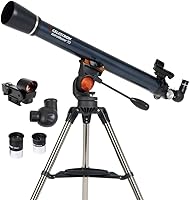
Celestron AstroMaster 70AZ Refractor Telescope for Moon
 Best for guided family stargazing
Celestron StarSense Explorer LT 80AZ Smartphone Guided
Celestron StarSense Explorer vs AstroMaster: which is easier to use?
StarSense Explorer is easier for finding unfamiliar targets, while AstroMaster is simpler if you want direct manual control. Both ranges are designed for beginners, but they teach different parts of the observing process.
With StarSense Explorer, you dock a compatible smartphone, open the app and follow on-screen arrows. The app uses sky recognition to calculate the telescope's position and guides you until the target is centered.
The AstroMaster 70AZ uses a manual alt-azimuth mount and panhandle. You point up, down and side to side without a phone, then use the StarPointer red dot finderscope to help aim.
The AstroMaster 130EQ uses right ascension and declination slow-motion controls. Those controls can make tracking smoother, but an equatorial mount takes more practice than a simple alt-azimuth design.
Which range suits a first-time observer?
Choose StarSense Explorer if target finding is your main concern. The app can suggest objects based on your time and location, which gives a new observer a clear place to begin.
Choose AstroMaster if you want to understand manual pointing and don't want your observing session to depend on a phone. The 70AZ has a short learning curve because its mount moves in the same basic directions you see in the sky.
Our guide to the best telescope with app explains when phone guidance adds value. For phone-based target finding and attachment options, see our guide to the best telescope with phone attachment.
Which has the better aperture for observing?
The AstroMaster 130EQ has the largest aperture, while the StarSense Explorer LT 114AZ offers the best balance of larger optics and phone guidance. Aperture affects how much light the telescope can collect, but it isn't the only part of the viewing experience.
The AstroMaster 70AZ has a 70mm achromatic refractor. It is suited to the Moon, planets, bright star clusters and daytime landmarks.
The StarSense Explorer LT 80AZ steps up to an 80mm refractor. Its high-reflectivity coatings support views of the Moon, Jupiter, Saturn, the Orion Nebula and the Andromeda Galaxy.
The StarSense Explorer LT 114AZ uses a 114mm Newtonian reflector. It offers more aperture than the LT 80AZ while keeping the StarSense phone-guidance system.
The AstroMaster 130EQ has a 130mm Newtonian reflector. It offers the most aperture in this comparison, along with an equatorial mount and manual slow-motion controls.
A larger mirror doesn't automatically make a telescope easier. You still need a stable setup, sensible magnification and a clear view with limited light pollution.
Which telescope is best for planets and the Moon?
The AstroMaster 70AZ is the simplest choice for basic Moon and planet viewing, while the LT 114AZ and AstroMaster 130EQ offer more aperture for detail. StarSense guidance can help you locate planets, but the optical design determines how the view is formed.
The AstroMaster 70AZ includes 20mm and 10mm eyepieces, plus an erect image diagonal. Its refractor design also supports right-side-up daytime views of wildlife and distant landmarks.
The LT 80AZ is another refractor option. Its 80mm optics and StarSense guidance suit a family that wants to find Jupiter, Saturn and lunar targets without learning a sky map first.
The LT 114AZ and AstroMaster 130EQ are Newtonian reflectors with larger apertures. They are better fits when you want to move beyond easy lunar targets and explore brighter deep-sky objects.
The Celestron StarSense Explorer DX 5 review is a useful next read if you are considering a larger StarSense design. You can also compare more models in our Celestron StarSense reviews.
Which is better for deep-sky beginners?
The AstroMaster 130EQ is the strongest choice for maximum aperture, while the StarSense Explorer LT 114AZ is the easier guided choice. Both use 4.5 in-class Newtonian optics, but only the StarSense model helps locate targets with a phone.
The LT 114AZ combines a 114mm Newtonian reflector with a manual alt-azimuth mount. Follow the app's arrows, then use the telescope's controls to keep the object in view.
The AstroMaster 130EQ has a 130mm Newtonian reflector and a German equatorial mount. Its slow-motion controls let you make fine adjustments in right ascension and declination as the sky appears to move.
Pick the LT 114AZ when you want to spend less time learning star positions. Pick the 130EQ when you want to learn manual tracking and get the largest aperture in this group.
The best eyepieces for the Celestron AstroMaster 114 can help you think through future viewing needs, but start with the included 25mm and 10mm eyepieces before changing your setup.
How do the mounts change the observing experience?
Alt-azimuth mounts are more direct, while the equatorial mount offers a more structured way to track objects. Your choice should match how much setup and practice you want before a night of observing.
The AstroMaster 70AZ, StarSense Explorer LT 80AZ and StarSense Explorer LT 114AZ use manual alt-azimuth mounts. They move up, down and side to side, which feels natural for casual viewing.
The LT 80AZ and LT 114AZ also include altitude slow-motion adjustment with a sliding rod. This gives you more control while following the StarSense arrows and centering a target.
The AstroMaster 130EQ uses a German equatorial mount. Its right ascension and declination controls are useful for smooth manual adjustments, but you need to learn how the mount's axes relate to the sky.
A mount can limit a telescope with excellent optics if it shakes or feels hard to control. Set up on a level surface, extend the tripod carefully and give the image time to settle after each adjustment.
Which telescope works best for families?
The StarSense Explorer LT 80AZ is the easiest family choice when several people want to find targets quickly. The AstroMaster 70AZ also suits families who want simple Moon, planet and daytime viewing without phone setup.
The LT 80AZ weighs 9.2 lb and has a preassembled mount and tripod. Its smartphone dock and app give children and adults a shared task during a session.
That shared task matters more than it first sounds. One person can hold the phone and read the arrows, while another moves the telescope and checks the eyepiece.
The LT 80AZ uses an 80mm refractor for the Moon, Jupiter, Saturn, the Orion Nebula and the Andromeda Galaxy. Those targets give a family a clear mix of easy wins and brighter deep-sky views.
Setup stays familiar because the mount is manual and alt-azimuth.
The AstroMaster 70AZ weighs 10.8 lb fully assembled and includes a sturdy adjustable tripod. Its manual panhandle keeps the controls easy to explain to a younger observer.
Its 70mm refractor design also supports right-side-up daytime viewing. That gives the same telescope a second life for wildlife, distant landmarks and general exploration.
For a family that wants night and day use, that daytime role can be a real bonus. It also means the telescope can earn its storage space between clear nights.
The LT 114AZ weighs 10.4 lb and offers more aperture for a family that wants brighter deep-sky targets. It still uses the same basic phone-guided process as the LT 80AZ.
A larger reflector can make faint objects more rewarding once a family knows where to look. It suits a household that has already enjoyed the Moon and wants the next step.
The AstroMaster 130EQ weighs 17 lb, so it is the heaviest option here. A family should think about stairs, car trips and storage before choosing the largest aperture.
Consider the observer's patience as much as the telescope's size. A smaller telescope that gets used often can be a better fit than a larger model that feels difficult to set up.
Short sessions often work best for children, and quick setup helps protect that routine. The AstroMaster models also come with a free download of astronomy software for indoor planning.
What should you check before choosing?
Choose by guidance, optical design, aperture and mount in that order. Those four questions narrow the choice without relying on a single specification.
First, decide if you want smartphone guidance. If yes, choose the LT 80AZ for a lighter refractor approach or the LT 114AZ for more aperture.
Next, decide if you prefer a refractor or reflector. Refractors offer an enclosed optical tube and right-side-up viewing with the AstroMaster 70AZ, while Newtonian reflectors offer larger apertures in the LT 114AZ and AstroMaster 130EQ.
Then consider the mount. Alt-azimuth is direct and beginner-friendly.
Equatorial offers more structured tracking but needs extra learning.
Finally, think about where you will observe. A backyard near city lights may favor Moon, planets and bright clusters, while a darker site can make more deep-sky targets visible.
Our guide, How Do I Know What Telescope to Choose? What to Know, gives a broader way to match a telescope to your goals.
If astrophotography is your priority, read Celestron vs Meade for Astrophotography before choosing a visual beginner telescope.
Which Celestron should you choose?
Pick the StarSense Explorer LT 80AZ if you want the easiest guided start, or the LT 114AZ if you want more aperture with the same phone-guidance idea. Choose the AstroMaster 70AZ for simple manual viewing, or the AstroMaster 130EQ for the largest aperture and a more involved equatorial learning path.
The Celestron StarSense Explorer vs AstroMaster decision is not about one range winning every use. It is about choosing between guided target finding, direct manual control, smaller refractor simplicity and larger reflector aperture.
For the quickest route to unfamiliar objects, choose StarSense Explorer. The app suggests targets for your time and location, then arrows guide you until the object is centred in the eyepiece.
That guidance suits a beginner who wants success early. It also suits a family where several people want to take turns without learning a star chart first.
For a more traditional observing skill set, choose AstroMaster. Manual pointing teaches you how the sky moves and where bright objects sit relative to each other.
The AstroMaster 70AZ is the simplest manual option in this group. Its alt-azimuth panhandle and red dot finderscope make basic Moon, planet and daytime viewing easy to explain.
The AstroMaster 130EQ points in another direction. Its 130mm Newtonian reflector is the largest aperture here, and its equatorial mount rewards patience with smoother manual tracking.
If you want the biggest optical step in this group, choose the 130EQ, provided you are ready to learn its equatorial mount. Larger optics help faint targets, but they do not remove the need for a stable setup.
Refractors bring their own appeal for some buyers. The 70AZ and LT 80AZ offer enclosed tubes and simple care, which can feel reassuring for a first purchase.
Reflectors bring larger apertures for the price in this comparison. The LT 114AZ and 130EQ suit buyers who care more about light gathering than an enclosed tube.
Weight should also factor into the final call. The LT 80AZ is the lightest option here, while the 130EQ asks for more effort to move and store.
Your observing site matters too. Under bright city lights, easy Moon and planet targets may matter most, while darker skies let deep-sky aperture show its value.
Choose by the session you imagine most often. Guided viewers will enjoy StarSense Explorer, manual learners will enjoy AstroMaster, and each range has a clear place in a beginner setup.
Frequently asked questions
Is Celestron StarSense Explorer better than AstroMaster?
StarSense Explorer is better if you want smartphone guidance to help locate targets. AstroMaster is better if you prefer direct manual controls or want the 130mm aperture and equatorial mount of the AstroMaster 130EQ.
The right choice depends on target finding, aperture and your comfort with the mount.
What is the main difference between StarSense Explorer and AstroMaster?
The main difference is target finding and mount style. StarSense Explorer models use a smartphone dock and StarSense guidance with manual alt-azimuth mounts, while the AstroMaster options here use traditional manual pointing.
The AstroMaster 130EQ also has a German equatorial mount.
Which is better for beginners, the StarSense Explorer LT 80AZ or AstroMaster 70AZ?
The LT 80AZ is better for beginners who want phone-guided target finding, while the AstroMaster 70AZ suits beginners who want simple manual controls. The LT 80AZ has an 80mm refractor, and the AstroMaster 70AZ has a 70mm refractor for Moon, planet and daytime viewing.
Which Celestron telescope has the largest aperture here?
The Celestron AstroMaster 130EQ has the largest aperture here at 130mm. That Newtonian reflector gathers more light than the 114mm StarSense Explorer LT 114AZ, the 80mm LT 80AZ and the 70mm AstroMaster 70AZ, but its equatorial mount requires more learning.
Can StarSense Explorer help you find deep-sky objects?
Yes. StarSense Explorer uses smartphone sky recognition and on-screen arrows to guide you toward targets such as nebulae, galaxies and star clusters.
The LT 80AZ and LT 114AZ both use this system, while the AstroMaster models rely on manual pointing and a red dot finderscope.